A refrigerator may stop cooling after a brief power event. A split AC may start tripping its breaker. A washing machine may reset halfway through a cycle. These faults can look like separate appliance problems, but the real cause may be the electrical supply, wiring, outlet, grounding, or protection system serving the appliance.
That distinction matters. Replacing a control board, compressor, capacitor, or motor without correcting the electrical fault can lead to another failure. It can also create a shock or fire risk. This guide explains the common electrical problems that damage appliances, the warning signs to watch for, safe checks you can make, and when to call an appliance technician or an EWA-approved electrical contractor.
Quick Answer
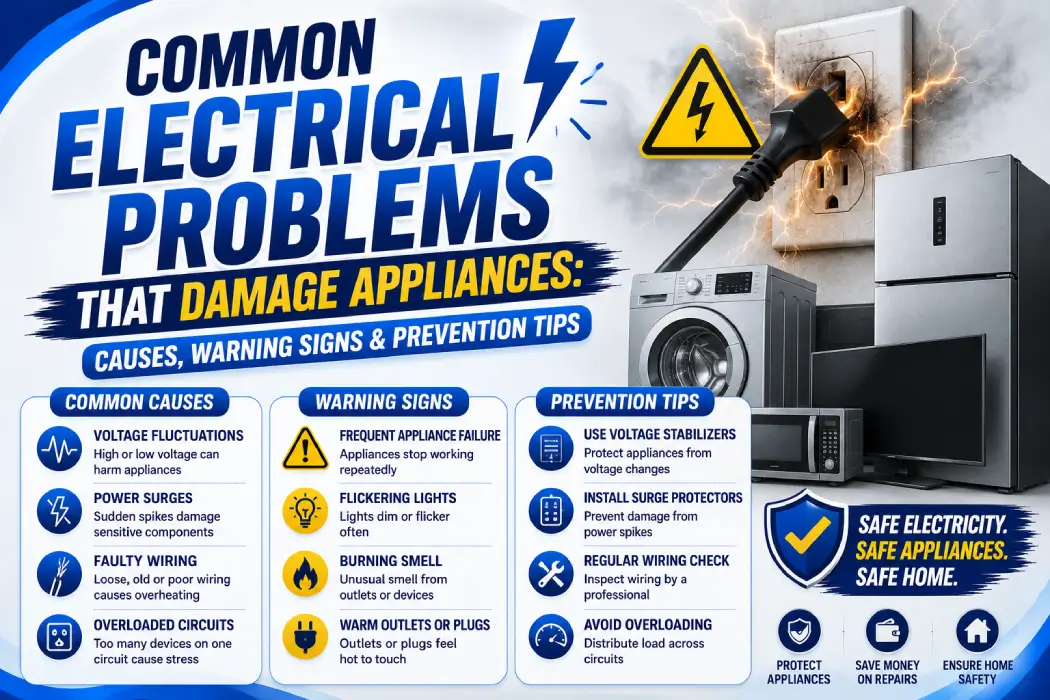
The most common electrical problems that damage appliances are voltage surges, low or high voltage, overloaded circuits, loose wiring, poor earthing, damaged outlets, incorrect cable or breaker sizing, repeated power interruptions, and moisture-related corrosion. These faults can burn control boards, overheat motors, weaken compressors, damage heating elements, and create serious shock or fire hazards.
Key Takeaways
- A breaker that trips repeatedly is warning you about a fault; it is not an inconvenience to bypass.
- Warm plugs, flickering lights, burning smells, buzzing outlets, and small electric shocks need immediate attention.
- Surge protectors help with brief voltage spikes but do not correct sustained low voltage, high voltage, poor earthing, or unsafe wiring.
- When several appliances show symptoms on the same circuit, inspect the building’s electrical system before replacing more appliance parts.
- In Bahrain, EWA advises customers to use approved contractors, avoid unauthorized load increases, and regularly inspect wiring, connections, grounding, and electrical loads.
What Is an Electrical Appliance-Damaging Fault?
An appliance-damaging electrical fault is any condition that delivers unsafe, unstable, insufficient, or poorly controlled power to an appliance. The problem may be outside the appliance, such as a loose outlet connection, or inside it, such as a shorted motor winding. Either way, excess heat, abnormal current, or incorrect voltage can damage electrical components.
Modern appliances are especially sensitive because many use electronic control boards, sensors, inverter drives, displays, and communication modules. A traditional appliance with a simple mechanical switch may survive a small disturbance, while a modern PCB can fail instantly or develop a hidden weakness that appears days later.
10 Common Electrical Problems That Damage Appliances
1. Voltage Surges and Short Spikes
A voltage surge is a brief rise above the normal supply level. Surges can come from switching large loads, faults within a building, restoration after an interruption, or external electrical events. Sensitive boards, inverter modules, thermostats, and communication circuits may be damaged even when the event is too fast for a standard breaker to trip.
Possible warning signs include an appliance that suddenly goes dead, a burnt smell near a board, a failed display, corrupted settings, or several electronic devices failing around the same time. NIST guidance explains that surges can originate outside a property or from load switching inside the local electrical system, and that they can damage sensitive electronic equipment.
Prevention: Use correctly selected surge protective devices, maintain effective earthing, and have a qualified contractor inspect the distribution board. Point-of-use protection may help electronic appliances, while a panel-mounted device can provide broader protection. No surge device can compensate for defective wiring or poor grounding.
2. Sustained Overvoltage
Overvoltage lasts longer than a momentary surge. It may be caused by a wiring fault, neutral problem, incorrect connection, faulty regulator, or an issue within a private electrical system. Sustained high voltage creates extra heat in motors, power supplies, heating elements, lamps, and electronic boards.
Symptoms may include unusually bright lights, hot power supplies, frequent bulb failures, a strong electrical smell, appliances running louder, or repeated board failures. This is not a DIY diagnosis. Switch off affected equipment and call an approved electrical contractor, especially when symptoms appear across more than one room or appliance.
3. Low Voltage and Voltage Drop
Low voltage can occur when a circuit is overloaded, cables are undersized, connections are loose, or a motor starts on a weak circuit. Long cable runs and poorly planned extensions can also create excessive voltage drop. Motors then draw abnormal current, produce less torque, run hotter, and may fail to start cleanly.
This matters for compressors and pumps in AC systems, refrigerators, chillers, washing machines, dishwashers, and dryers. You may hear humming, repeated clicking, slow motor operation, dimming lights, or a compressor attempting to start and stopping. U.S. Department of Energy guidance notes that undervoltage can reduce motor efficiency, increase overheating, and shorten motor life.
4. Loose or Failing Neutral Connection
A neutral conductor provides the return path for many circuits. When it becomes loose, damaged, or poorly terminated, voltages can become unstable. The result may be flickering lights, appliances changing speed, displays resetting, unusual brightness in some lights, or multiple failures that seem unrelated.
A loose neutral can be dangerous because symptoms may come and go as loads switch on and off. Do not keep testing appliances on the affected circuit. Turn off sensitive equipment and arrange an urgent electrical inspection. Appliance repair alone will not solve the source of the problem.
5. Overloaded Circuits
An overloaded circuit carries more current than its cable, breaker, outlet, or connection is designed to handle. This often happens when several high-load appliances share one circuit, such as a dryer, electric stove, dishwasher, kettle, or portable heater. In offices and restaurants, added equipment can push an older circuit beyond its intended load.
Signs include repeated breaker trips, hot outlets, discoloured plugs, a burning-plastic smell, buzzing, and lights dimming when a major appliance starts. EWA specifically warns that unauthorized load increases may overload cables and fuses that were not selected for the added demand.
6. Incorrect Breaker, Fuse, or Cable Sizing
A breaker protects wiring by disconnecting power when current becomes unsafe. Installing a larger breaker to stop nuisance tripping does not fix the fault; it may allow the cable to overheat before protection operates. Similarly, an undersized cable can heat up under a load that the appliance itself handles normally.
EWA advises customers to consult the authority before increasing electrical loads and to use approved contractors for electrical connections and extensions. Its customer terms also require compliance with licensed loads and regular checks of wiring, connections, grounding, and load efficiency.
7. Poor Earthing or Faulty Protection
Earthing provides a safer path for fault current and supports protective devices in disconnecting a dangerous circuit. Poor earthing may not stop an appliance from operating, which is why the problem can remain hidden until someone feels a tingle from a metal body or a fault develops.
Warning signs include small shocks from washing machines, dishwashers, refrigerators, stoves, or metal taps near appliances. Never treat this as normal static electricity. Stop using the appliance, avoid touching it while wet or barefoot, and call an approved contractor. EWA states that earthing and protection systems should be checked because they help disconnect current during an electrical fault.
8. Loose Plugs, Damaged Sockets, and Burnt Connections
A loose connection creates resistance. Resistance creates heat, and heat further weakens the connection. This cycle can melt plugs, burn outlet terminals, damage appliance cords, and cause intermittent voltage loss that stresses motors and control boards.
Look for a plug that feels warm, black marks, cracking, a loose socket face, buzzing, sparking, or an appliance that switches off when the cord moves. Do not continue using the outlet. A plug or extension cord becoming hot is also a recognized overload or damage warning.
9. Frequent Power Interruptions and Rapid Restarting
A power cut does not automatically damage an appliance. The higher-risk moment can be the interruption, unstable restoration, or immediate restart of a compressor while pressure is still equalizing. AC units, refrigerators, freezers, and chillers may draw a heavy starting current if they restart too quickly.
After an interruption, follow the manufacturer’s instructions. Where appropriate, use a correctly specified time-delay or voltage-protection device for compressor equipment. Avoid repeatedly switching a struggling appliance on and off. If the unit clicks, hums, or trips the breaker, leave it off and request diagnosis.
10. Heat, Humidity, Dust, and Corrosion Around Electrical Parts
Bahrain’s heat, humidity, airborne dust, and heavy cooling demand can make an existing electrical weakness worse. Dust restricts airflow and traps heat. Humidity and coastal air can encourage corrosion at terminals, boards, contactors, sensors, and connectors. Long AC and refrigeration run times also leave less cooling time for stressed components.
These conditions do not mean every failure is caused by the grid. More often, climate and heavy use expose weak capacitors, loose terminals, dirty coils, or undersized circuits sooner. Fix Bahrain’s related guide explains how Bahrain’s climate increases strain on compressors, seals, coils, and electrical components.
Warning Signs and the Recommended Action
| Warning sign | What it may mean | Recommended action |
|---|---|---|
| Breaker trips once during an unusual event | Temporary overload or appliance fault | Unplug the appliance, inspect externally, and reset once only |
| Breaker trips repeatedly | Short circuit, earth fault, overload, motor, or wiring problem | Stop using the circuit and call a professional |
| Plug or outlet feels hot | Loose connection, overload, or damaged contact | Switch off and arrange an electrical inspection |
| Lights flicker when an appliance starts | Voltage drop, weak connection, or overloaded circuit | Have the circuit tested under load |
| Burning smell, smoke, or sparks | Active overheating or arcing | Cut power if safe, keep clear, and request emergency help |
| Appliance gives a tingle or shock | Earthing or insulation fault | Disconnect immediately and do not touch while wet |
| Several appliances reset together | Shared circuit or supply-quality issue | Call an electrical contractor before replacing appliance boards |
| One appliance hums, clicks, or will not start | Low voltage, start component, motor, compressor, or board fault | Leave it off and book appliance diagnosis |
How Electrical Faults Affect Different Appliances
| Appliance | Parts commonly at risk | Typical electrical symptoms |
|---|---|---|
| Split or central AC | Capacitor, contactor, PCB, fan motor, compressor winding | Breaker trips, buzzing, fan runs without cooling, random shutdown |
| Refrigerator or freezer | Start relay, inverter board, thermostat, compressor | Clicking, display reset, weak cooling, compressor not starting |
| Washing machine | Control board, motor drive, drain pump, heater, door lock | Cycle stops, error codes, shocks, breaker trips |
| Dryer | Motor, heater, thermal protection, terminal block | No heat, slow drum, hot plug, burning smell |
| Dishwasher | PCB, heater, pump, wiring, leakage protection | Mid-cycle shutdown, no heating, tripping, tingling metal body |
| Electric stove | Heating element, selector switch, terminal connection | Burner not heating, sparks, uneven heat, hot outlet |
| Chiller AC | Contactor, phase protection, controls, pumps, compressor | Alarms, nuisance trips, poor starting, compressor overheating |
| Steam iron | Cord, thermostat, thermal fuse, heating element | Intermittent heat, sparking cord, hot plug, no heat |
For appliance-specific diagnosis, use the relevant service guide: AC repair in Bahrain, refrigerator repair in Bahrain, washing machine repair in Bahrain, dryer repair in Bahrain, dishwasher repair in Bahrain, electric stove repair in Bahrain, chiller AC repair in Bahrain, and iron repair in Bahrain.
Safe Step-by-Step Troubleshooting
Step 1: Stop When There Is an Immediate Hazard
Turn the appliance off and isolate power if you notice smoke, sparks, a burning smell, melted plastic, a hot outlet, water near electrical parts, or an electric shock. Do not pull a hot or damaged plug with bare hands. If safe isolation is uncertain, keep away and call emergency electrical support.
Step 2: Decide Whether the Problem Is Local or Widespread
Ask whether only one appliance is affected. Check whether lights flicker, another outlet has failed, or several appliances reset at the same time. A single faulty appliance usually points toward its cord or internal components. Several symptoms on one circuit suggest wiring, load, breaker, neutral, or outlet problems.
Step 3: Inspect Without Opening the Appliance
With power disconnected, look at the plug, cable, outlet face, and surrounding area. Check for cuts, crushed insulation, dark marks, moisture, loose pins, or melted plastic. Do not remove panels, touch capacitors, or probe live terminals. Some appliances store electrical energy even after being unplugged.
Step 4: Check the Breaker Once
Identify the correct breaker and inspect its position. After unplugging the affected appliance, a breaker may be reset once if there is no smoke, heat, burning smell, water, or visible damage. If it trips again, stop. Repeated resetting can energize a serious fault over and over.
Step 5: Review Recent Changes
Think about what changed before the fault began. Was a new AC, stove, dryer, chiller, freezer, or office machine added? Was an extension installed? Did maintenance occur? Has the appliance been moved? These details help a technician identify load changes, damaged cables, incorrect connections, or poor ventilation.
Step 6: Record the Pattern
Note the time, appliance mode, sounds, error code, breaker involved, and whether the fault occurs during startup, heating, draining, or high cooling demand. A short video of the display or sound can help, provided it is safe to take one. Good information reduces diagnostic time and unnecessary part replacement.
Step 7: Choose the Right Professional
Call an appliance technician when the fault is limited to one machine and appears internal. Call an EWA-approved electrical contractor when several appliances are affected, outlets are hot, lights flicker, breakers trip across a circuit, earthing is questionable, or a new load has been added. Some cases need both professionals.
DIY Checks vs Professional Work
| Task | Safe for most users? | Who should handle it? |
|---|---|---|
| Read the manual and note an error code | Yes | User |
| Inspect a disconnected plug and cord visually | Yes | User |
| Clean an accessible AC filter or dryer lint filter | Yes | User |
| Reset a breaker once after unplugging the load | Sometimes | User, only with no hazard signs |
| Replace a wall outlet or breaker | No | Approved electrical contractor |
| Test voltage, neutral, insulation, or earthing | No | Approved electrical contractor |
| Open an appliance control panel | No | Qualified appliance technician |
| Replace a compressor, PCB, motor, heater, or internal wiring | No | Qualified appliance technician |
| Increase the property’s electrical load | No | EWA and an approved contractor |
Surge Protector, Voltage Protector, Stabilizer, or UPS?
These devices solve different problems. Buying the wrong one can create false confidence.
| Device | Main purpose | What it does not fix |
|---|---|---|
| Surge protective device | Limits brief voltage spikes | Sustained overvoltage, undervoltage, bad wiring, poor earthing |
| Voltage protector with delay | Disconnects outside set voltage limits and delays restart | Loose connections, overloaded cables, internal appliance faults |
| Automatic voltage regulator or stabilizer | Adjusts certain sustained voltage variations within its rated range | Major wiring faults, short circuits, defective earthing |
| UPS | Provides temporary backup and may condition power, depending on design | High-load appliance protection unless specifically rated |
| Dedicated circuit protection | Matches cable, breaker, isolation, and load requirements | Internal mechanical or refrigerant faults |
For refrigerators, AC units, freezers, and chillers, protection must be selected for compressor starting current and manufacturer requirements. Do not connect a large appliance to a cheap multi-socket strip. NIST distinguishes surge protection from longer overvoltage conditions, while CPSC warns against overloading extension cords or using them as permanent wiring.
A Typical Real-Life Pattern
Suppose a split AC starts, nearby lights dim, and a refrigerator display resets. Replacing the refrigerator board first would be premature. The shared pattern points toward voltage drop, a loose connection, an overloaded circuit, or a hard-starting AC compressor. The safest approach is to test the circuit under load and diagnose the AC before replacing unrelated parts.
Common Mistakes That Make the Damage Worse
- Resetting a breaker again and again without finding the cause.
- Replacing a control board but ignoring the outlet, neutral, or voltage problem that damaged it.
- Using a larger fuse or breaker to stop tripping.
- Running an AC, refrigerator, dryer, dishwasher, or stove through an underrated extension lead.
- Treating a warm plug, buzzing outlet, or occasional spark as normal.
- Using adapters that remove the earth connection.
- Restarting compressor equipment repeatedly after a power interruption.
- Allowing water leaks from AC units, washing machines, or dishwashers to reach wiring.
- Hiring an unapproved person for load increases or distribution-board work.
EWA’s current safety guidance tells customers to use approved contractors, contact EWA before increasing electrical loads, and conduct regular maintenance of installations, wiring, earthing, and protection systems.
Preventive Maintenance Checklist
Monthly
- Check plugs, cords, and accessible outlets for heat, looseness, cuts, or dark marks.
- Clean AC filters and dryer lint filters according to use.
- Keep appliance ventilation openings clear.
- Watch for new error codes, resets, noise, or longer running time.
Every Three to Six Months
- Clean refrigerator condenser areas where the manufacturer allows user access.
- Check that outdoor AC condensers have airflow and are not buried in dust or stored items.
- Inspect areas behind washing machines and dishwashers for water leaks.
- Review whether new appliances have been added to existing circuits.
Periodically or at Least Annually for Higher-Risk Properties
- Arrange an electrical inspection based on the building’s age, use, and condition.
- Test earthing and protective devices through a competent contractor.
- Inspect commercial equipment, distribution boards, isolators, and high-load circuits.
- Service AC and chiller systems before peak demand.
- Review recurring failures instead of treating each repair as unrelated.
Properties with heavy commercial use, older wiring, frequent tenant changes, coastal exposure, or repeated breaker trips may need shorter inspection intervals. EWA places responsibility on customers to arrange regular inspection of wiring, connections, grounding, and electrical load efficiency through a certified contractor.
What Professional Diagnosis Usually Includes
A proper diagnosis begins with the symptom but does not end there. The technician may inspect the cord, terminal block, control board, motor, compressor, heater, insulation, sensors, and connectors. An electrical contractor may measure supply voltage under load, voltage drop, current, earthing, insulation resistance, circuit loading, breaker condition, and neutral integrity.
The goal is to identify the first cause, not only the last failed part. For example, a burnt AC capacitor may be the immediate fault, but a dirty condenser, high operating temperature, loose terminal, or supply problem may explain why it failed. Repair quality improves when the whole chain is checked.
What Affects Repair Cost?
There is no honest flat price for electrical appliance damage because two appliances with the same symptom may need very different work. Cost is affected by the diagnostic time, failed part, appliance age, brand, part availability, wiring access, circuit condition, property type, and whether an electrician and appliance technician are both required.
Control boards, inverter modules, compressors, and commercial chiller components usually involve more cost than plugs, cords, switches, relays, or isolated terminals. Emergency attendance and business downtime may also affect the decision. Ask for a diagnosis and written quotation before approving major work.
Repair vs Replacement
| Repair is usually sensible when | Replacement deserves consideration when |
|---|---|
| The appliance is relatively young | The appliance is near the end of its expected service life |
| Damage is limited to one available component | Several major parts are damaged |
| The electrical root cause has been corrected | The appliance has repeated electrical failures |
| The cabinet, motor, compressor, and wiring are otherwise sound | Wiring, insulation, or terminals are extensively burnt |
| Repair cost is reasonable compared with a suitable replacement | Major repair approaches the value of a more efficient new unit |
| The model has reliable parts support | Parts are obsolete or unavailable |
Do not replace an appliance before checking the circuit when multiple devices have failed. A new refrigerator, AC board, or washing machine can be damaged by the same unresolved electrical issue. On the other hand, do not keep repairing an appliance with heat-damaged wiring, degraded insulation, or repeated safety faults simply because it can still run.
Expert Recommendations for Bahrain Homes and Businesses
First, separate appliance faults from property electrical faults. A technician should not guess that every compressor failure is “bad electricity,” and an electrician should not assume every breaker trip is an overloaded circuit. Measurements under the actual operating load are the fastest path to a reliable answer.
Second, plan high-load equipment before installation. Villas in Riffa, Isa Town, or Hamad Town, apartments in Juffair or Manama, offices in Seef, and restaurants in Muharraq may have different load patterns, but each needs correctly sized circuits, protection, isolation, and ventilation. EWA should be consulted where an electrical load increase is required.
Third, keep a repair history. If two PCBs, capacitors, relays, or motors fail within a short period, share that information with the next technician. Repeated failures are evidence. They may point to heat, water ingress, poor connections, unstable voltage, incorrect installation, or a missed mechanical problem.
For more context on heat, humidity, dust, and usage, read why home appliances break down faster in Bahrain. For symptom-specific help, see the guides on AC not cooling, refrigerator not cooling properly, washing machine maintenance, slow dryer performance, and an electric stove not heating.
Conclusion
The common electrical problems that damage appliances rarely stay harmless for long. Voltage surges, low voltage, loose neutrals, overloaded circuits, poor earthing, burnt outlets, and incorrect protection can destroy expensive parts while creating a safety risk for the people using them.
Pay attention to early signs. A flicker, warm plug, random reset, breaker trip, or small shock is useful information, not something to ignore. Stop unsafe operation, avoid repeated resets, and have the appliance and its electrical supply checked before another component fails.
Fix Bahrain provides appliance diagnosis and repair across Manama, Muharraq, Riffa, Isa Town, Hamad Town, Seef, Juffair, and other areas of Bahrain. Book the relevant service for AC repair, refrigerator repair, washing machine repair, dryer repair, dishwasher repair, electric stove repair, chiller AC repair, or iron repair.
Frequently Asked Questions
1. Can a power surge damage an appliance even if the breaker does not trip?
Yes. A standard breaker mainly responds to excessive current over a certain time. A brief voltage spike can reach a sensitive control board faster than the breaker reacts. The appliance may fail immediately, reset unexpectedly, or develop a weakened component that fails later. Surge protection can reduce risk, but it must be correctly installed and supported by proper earthing.
2. Why does my breaker trip when the AC or refrigerator starts?
Compressors draw higher current during startup. A trip may be caused by a weak capacitor, failing compressor, shorted winding, low voltage, loose connection, overloaded circuit, or incorrect breaker and cable arrangement. Reset the breaker only once after switching off the appliance. If it trips again, leave the equipment off and arrange professional testing.
3. Can low voltage damage a refrigerator or AC compressor?
Yes. Low voltage can make a motor draw abnormal current, reduce starting torque, and run hotter. A compressor may hum, click off on protection, or repeatedly attempt to start. Continued operation can damage the start components or winding. The technician should test the supply while the compressor is trying to start, not only when the appliance is off.
4. Is a surge protector the same as a voltage stabilizer?
No. A surge protector limits short, high-voltage spikes. A stabilizer or automatic voltage regulator adjusts certain longer voltage variations within its design limits. A voltage-protection relay may disconnect the load when voltage is too high or low. None of these devices repairs loose wiring, an overloaded circuit, poor earthing, or an internal appliance fault.
5. Why is my appliance plug or wall socket getting hot?
Heat commonly points to a loose contact, damaged socket, overloaded connection, poor-quality adapter, or a cord that is not rated for the load. Stop using it. Do not cool it and plug it back in. The outlet and appliance plug should be inspected because ongoing resistance heating can melt insulation and damage both the appliance and building wiring.
6. Is it safe to use an extension cord for a washing machine, dryer, or refrigerator?
Permanent use is generally a bad idea, especially for high-load or motor-driven appliances. An extension can be undersized, damaged, ungrounded, or placed where heat cannot escape. CPSC safety guidance warns against overloading extension cords and using them as permanent household wiring. A correctly installed outlet and dedicated circuit are safer.
7. What does a small shock from an appliance mean?
A tingle or shock from a metal appliance may indicate leakage current, damaged insulation, moisture, or ineffective earthing. Stop using the appliance immediately. Do not test it again while barefoot or touching water. An appliance technician should check internal insulation, while an approved electrical contractor should verify earthing and protective operation. EWA recommends regular checks of earthing and protection systems.
8. Should I unplug appliances after a power outage?
For sensitive electronics and compressor appliances, switching them off during an unstable interruption and following the manufacturer’s restart guidance can be sensible. After power returns, avoid rapid on-off cycling. A correctly selected time-delay voltage protector may help certain refrigerators, freezers, AC units, and chillers, but it must be rated for the appliance’s starting current.
9. Who should I call first: an electrician or an appliance technician?
Call an appliance technician when one appliance has an isolated symptom such as an error code, failed heater, pump issue, or internal noise. Call an approved electrical contractor when multiple appliances are affected, lights flicker, sockets heat up, breakers repeatedly trip, or shocks occur. When the evidence overlaps, ask both professionals to coordinate rather than replacing parts by trial and error.
10. Why do appliance control boards fail repeatedly?
Repeated board failure often means the root cause has not been corrected. Possible causes include a surge, sustained voltage issue, loose neutral, poor earthing, overheating, water ingress, shorted loads connected to the board, or an installation fault. Before fitting another PCB, the technician should test the loads it controls and the electrical supply feeding the appliance.