
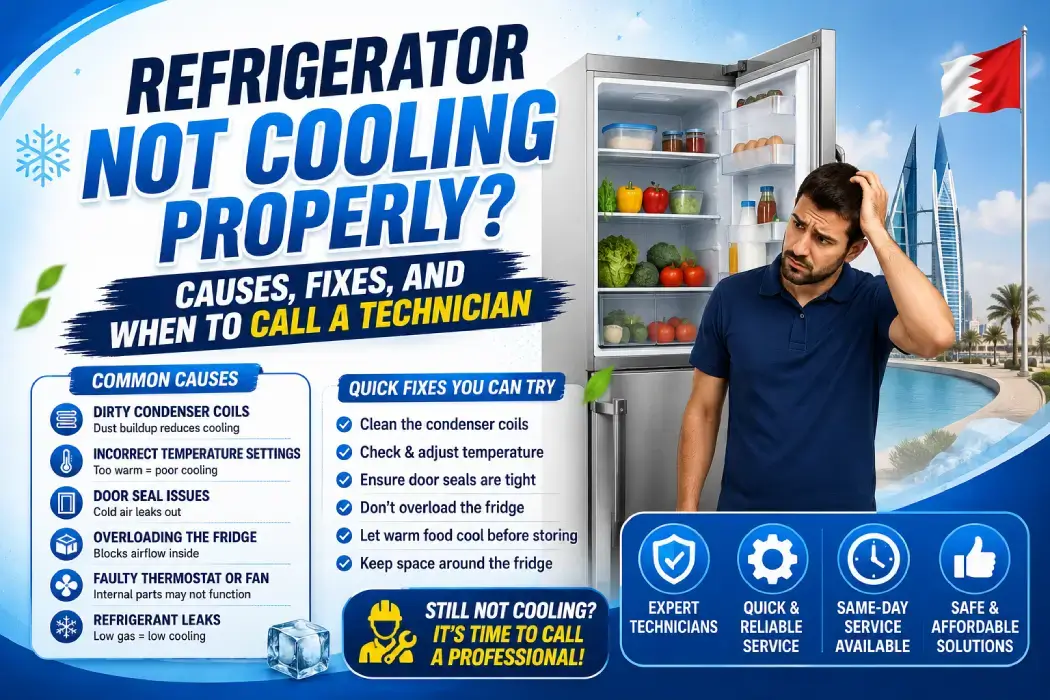
There’s a specific kind of stomach-drop that happens when you open the fridge and the milk isn’t cold. Maybe the light still works, maybe you can even hear the compressor humming, but something’s clearly off. Before you start worrying about losing a fridge full of groceries, it helps to know that a refrigerator not cooling properly usually has a specific, identifiable cause, and most of them are fixable.
This guide breaks down why refrigerators lose their cooling power, what you can check yourself in five minutes, and when the problem needs a certified technician rather than a YouTube tutorial.
Quick Answer
A refrigerator not cooling properly is usually caused by a dirty condenser coil, a faulty door seal, a failing compressor, a broken thermostat, or a blocked air vent inside the unit. In Bahrain’s warm, humid climate, dust buildup on the condenser coil and worn door gaskets are especially common, since both make the compressor work harder than it should.
Why This Happens More Often in Bahrain
Refrigerators in Bahrain run under tougher conditions than units in cooler climates. Kitchens stay warmer for longer stretches of the year, humidity accelerates rubber gasket wear, and dust from outdoor air settles on condenser coils faster than most homeowners expect. A fridge that’s fine in a temperate climate can start struggling here within a shorter timeframe if it isn’t maintained.
This applies whether you’re in an apartment in Juffair, a villa in Riffa, or running a commercial kitchen in Manama or Muharraq. Restaurants and shops in particular tend to notice cooling problems fast, since a warm walk-in or display fridge affects food safety immediately, not just comfort.
1. Dirty or Dusty Condenser Coils
The condenser coils, usually located at the back or underneath the fridge, release the heat that’s been pulled out of the interior. When they’re coated in dust, pet hair, or kitchen grease, they can’t release heat efficiently, and the whole cooling cycle slows down.
Symptoms: Fridge running longer than usual, warm air near the back or bottom vents, higher electricity bills, compressor sounding like it’s working harder than normal.
What to do: Unplug the fridge, gently vacuum the coils with a soft brush attachment, and make sure there’s enough space behind the unit for airflow. This should be done every 3 to 6 months, more often in dusty environments.
2. Worn or Damaged Door Seal (Gasket)
If the rubber gasket around the door is cracked, loose, or not sealing tightly, cold air escapes and warm air seeps in continuously. The compressor then runs nonstop trying to compensate, but the internal temperature still climbs.
Symptoms: Condensation or frost near the door edges, door doesn’t feel like it’s sealing firmly, a dollar-bill or paper test (closing the door on paper and pulling it out) slides out too easily.
Replacing a gasket is usually a straightforward, affordable fix compared to letting the compressor overwork itself for months, which can shorten the compressor’s lifespan considerably.
3. Thermostat Set Incorrectly or Malfunctioning
Sometimes the fix really is that simple. A thermostat accidentally bumped to a warmer setting, or a control board that’s misreading the internal temperature, can make a perfectly healthy fridge seem broken.
Symptoms: Inconsistent cooling between shelves, temperature display not matching how items actually feel, cooling improves temporarily after adjusting the dial then drifts again.
What to do: Check that the thermostat is set between 1-4°C for the fridge compartment. If adjusting it doesn’t change anything after a few hours, the thermostat itself may need testing or replacement by a technician.
4. Blocked Air Vents Inside the Fridge
Most refrigerators circulate cold air from the freezer section into the fridge compartment through internal vents. If these are blocked by overpacked shelves, large containers, or ice buildup, cold air can’t reach the main compartment properly.
Symptoms: Freezer stays cold while the fridge section stays warm, uneven cooling between shelves, ice buildup visible near the vent area.
What to do: Avoid overpacking shelves, especially directly in front of vents. Leave enough space for air to circulate freely between items, particularly in tall bottles or large trays that can block airflow paths entirely.
5. Failing or Worn-Out Compressor
The compressor is the core of the cooling system, and when it starts failing, the fridge often shows partial symptoms before stopping entirely, rather than failing all at once.
Symptoms: Fridge feels only slightly cool rather than cold, compressor cycling on and off rapidly, unusual buzzing or clicking sounds from the back of the unit, warmth radiating from the compressor area.
Compressor problems are not a DIY repair. They involve refrigerant lines, high-voltage electrical components, and specialized tools, and attempting a repair without proper training can make the unit unsafe or unrepairable.
6. Low or Leaking Refrigerant
Like an AC unit, a refrigerator relies on refrigerant to absorb and release heat. If there’s a leak somewhere in the sealed system, cooling performance drops gradually as refrigerant levels fall.
Symptoms: Gradual decline in cooling over weeks, oily residue near refrigerant lines, compressor running almost constantly without reaching target temperature.
A refrigerant leak requires a certified technician to locate, repair, and properly recharge the system, since this involves sealed components that shouldn’t be opened without the right equipment.
7. Condenser Fan Not Working
The condenser fan pulls air across the condenser coils to help release heat. If the fan motor fails or gets blocked by debris, the coils overheat and cooling efficiency drops sharply.
Symptoms: Compressor area feels unusually hot, no fan noise when the compressor is running, cooling worse than usual despite clean coils.
8. Evaporator Fan Problems
Located inside the freezer section, the evaporator fan circulates cold air throughout the unit. A faulty evaporator fan means the freezer might stay cold while the fridge section barely cools at all.
Symptoms: Freezer working fine but fridge warm, faint or absent fan noise when the door is closed, ice buildup around the evaporator coil itself.
9. Overloading the Refrigerator
Packing a fridge too full restricts airflow between items, meaning cold air can’t circulate evenly. This is one of the few causes that isn’t a mechanical fault at all, just a usage habit that undermines the system’s design.
Symptoms: Items at the front or door shelves warmer than items in the back, cooling seems fine right after grocery shopping then declines, uneven temperatures across shelves.
What to do: Leave gaps between containers and avoid stacking items directly against the back wall, where the coldest air typically enters the compartment.
10. Fridge Placed Too Close to a Wall or Heat Source
If a refrigerator is installed too close to a wall, cabinet, or a heat-generating appliance like an oven, the condenser can’t dissipate heat properly, and cooling efficiency drops over time.
Symptoms: Cooling worse in warmer months, condenser area consistently warm, gradual decline in performance since installation or a kitchen renovation.
What to do: Leave at least 5-10cm of clearance on the sides and back of the unit, and more if it’s positioned near an oven, stove, or a wall that receives direct sunlight.
11. Damaged or Cracked Interior Panels
Cracks in interior wall panels can create an air leak path that lets cold air escape into wall cavities rather than staying inside the compartment. This is less common but does happen in older units.
Symptoms: Cooling loss without an obvious external cause, visible cracks or gaps in interior walls, frost forming in unusual spots inside the fridge.
12. Power Supply or Electrical Issues
Occasionally, the fridge itself is fine, but it isn’t receiving stable power. Voltage fluctuations, a faulty outlet, or a failing start relay can all prevent the compressor from running consistently.
Symptoms: Fridge turning on and off unexpectedly, no cooling at all despite the interior light working, unusual clicking sound every few minutes without the compressor actually starting.
Step-by-Step Troubleshooting Before Calling a Technician
- Check that the thermostat is set correctly (1-4°C for the fridge, around -18°C for the freezer).
- Confirm the fridge is plugged in properly and the outlet has power.
- Check the door seal with the paper test on all sides of the door.
- Look behind and underneath the unit for dusty, blocked condenser coils.
- Make sure there’s proper clearance around the fridge for airflow.
- Check that internal vents aren’t blocked by overpacked shelves.
- Listen for unusual sounds: clicking, buzzing, or a compressor that won’t start.
If the fridge still isn’t cooling after these checks, it’s time to bring in a professional rather than keep guessing at the cause.
DIY vs Professional Repair
| Task | DIY Appropriate | Professional Required |
|---|---|---|
| Cleaning condenser coils | Yes | — |
| Checking door seal/gasket | Yes | — |
| Rearranging shelves for airflow | Yes | — |
| Adjusting thermostat setting | Yes | — |
| Replacing a door gasket | Sometimes | Recommended for a proper seal |
| Compressor diagnosis/replacement | No | Yes |
| Refrigerant leak repair | No | Yes |
| Electrical/power supply issues | No | Yes |
| Evaporator or condenser fan replacement | No | Yes |
Common Mistakes Homeowners Make
- Assuming a warm fridge just needs a colder thermostat setting without checking the actual cause.
- Overpacking shelves and blocking internal air vents.
- Ignoring a worn door gasket for months, which overworks the compressor.
- Placing the fridge flush against a wall with no airflow clearance.
- Repeatedly unplugging and restarting the unit instead of diagnosing the issue.
- Delaying a technician visit until food spoilage forces the issue.
Safety Precautions
Always unplug the refrigerator before cleaning coils or checking internal components. Never attempt to open the compressor housing or refrigerant lines yourself. If you notice a burning smell, sparking, or the unit tripping the breaker repeatedly, unplug it immediately and contact a certified technician rather than continuing to test it.
What Affects Repair Cost
Refrigerator repair costs vary based on a few genuine factors rather than one flat rate:
- Type of issue – a gasket replacement costs far less than a compressor repair.
- Refrigerant system complexity – some models have more complex sealed systems than others.
- Age of the unit – older fridges may need harder-to-source parts, affecting cost and timeline.
- Commercial vs residential units – commercial fridges and chillers often involve larger components and higher labor time.
- Accessibility – built-in or tightly fitted units may need extra time to access properly.
A proper diagnosis before any repair work means you know exactly what’s wrong and why, rather than paying for guesswork.
Repair vs Replacement Guidance
As a general rule, if your refrigerator is under 8 years old and the issue is isolated, gasket, thermostat, dirty coils, repair is almost always the more cost-effective choice. If the unit is past 10-12 years old, has needed multiple repairs recently, or requires a compressor or refrigerant system repair, it’s worth comparing that cost against a newer, more energy-efficient model.
Preventive Maintenance Checklist
- Clean condenser coils every 3 to 6 months, more often in dusty households.
- Check the door seal for gaps or cracks every few months.
- Keep at least 5-10cm of clearance around the unit for airflow.
- Avoid overpacking shelves, especially near internal air vents.
- Defrost manual-defrost freezers before ice buildup becomes excessive.
- Monitor electricity bills for unexplained increases, an early warning sign.
- Schedule a professional inspection annually, especially for units over 5 years old.
When to Call a Certified Technician
If you’ve checked the basics, thermostat setting, door seal, coil cleanliness, airflow clearance, and the fridge still isn’t cooling, it’s time to call in a professional. Compressor issues, refrigerant leaks, and electrical faults all require proper diagnostic tools and experience to repair safely. Fix Bahrain’s refrigerator repair service in Bahrain covers diagnosis, gasket replacement, compressor repair, refrigerant recharge, and full servicing for both home and commercial units.
Related Reading
If your fridge has other issues beyond weak cooling, these related guides may help:
- Refrigerator Water Leakage: Causes and Fixes
- Refrigerator Compressor Problems: Warning Signs to Watch
- Refrigerator Maintenance Guide for Bahrain Homes
And if it’s a different appliance giving you trouble, Fix Bahrain also handles AC repair, washing machine repair, dryer repair, dishwasher repair, electric stove repair, chiller AC repair, and iron repair across Bahrain.
Conclusion
A refrigerator that’s not cooling properly is rarely a mystery once you know what to check. Most cases come down to a handful of causes: dirty condenser coils, a worn door seal, blocked vents, or a component nearing the end of its lifespan. Many of these are preventable with regular maintenance, and the ones that aren’t are usually straightforward for a trained technician to diagnose quickly.
If your fridge still isn’t cooling after checking the basics, don’t wait until food starts spoiling. Reach out to Fix Bahrain’s refrigerator repair team for fast, reliable service across Manama, Riffa, Muharraq, Isa Town, Hamad Town, and the rest of Bahrain.
Frequently Asked Questions
Why is my fridge running but not cooling?
This usually points to a dirty condenser coil, a failing compressor, or a fan that isn’t circulating cold air properly. The compressor running doesn’t guarantee the cooling cycle is completing successfully, so it’s worth checking coils and airflow first.
Why is my freezer cold but my fridge section isn’t?
This is a classic sign of a blocked air vent or a failing evaporator fan. Cold air from the freezer isn’t reaching the fridge compartment, often because shelves are overpacked or the internal vent is obstructed by ice or containers.
How often should I clean my refrigerator’s condenser coils?
Every 3 to 6 months is a good general rule, though homes with pets, dusty environments, or kitchens near construction areas may need to clean coils more frequently to maintain efficient cooling.
Can a bad door seal really affect cooling that much?
Yes. A gap in the door seal lets cold air escape continuously, forcing the compressor to run far more than necessary. Over time, this doesn’t just waste electricity, it can shorten the compressor’s overall lifespan.
Is it normal for my fridge to run constantly in Bahrain’s summer?
Some increase in cycling is normal during hot months, but if it never seems to shut off or the interior still feels warm, that points to a dirty coil, worn seal, or refrigerant issue rather than just seasonal heat.
Why did my fridge stop cooling suddenly overnight?
A sudden, complete loss of cooling is more consistent with a compressor failure, electrical fault, or power supply issue rather than a gradual problem like dust buildup. This warrants a technician visit sooner rather than later.
Should I unplug my fridge if it stops cooling?
If you notice burning smells, sparking, or repeated breaker trips, unplug it immediately for safety. Otherwise, it’s usually fine to leave it plugged in while you troubleshoot, since restarting it repeatedly won’t fix an underlying issue.
How long should a refrigerator last before needing replacement?
Most residential refrigerators last 10 to 15 years with reasonable maintenance. Commercial units may have shorter lifespans depending on usage intensity, but proper coil cleaning and seal maintenance can extend performance either way.
Can overpacking my fridge really cause cooling problems?
Yes. Airflow is essential for even cooling. Overpacked shelves, especially near internal vents, block circulation and can leave some areas noticeably warmer than others, even though the fridge itself is functioning correctly.
What’s the difference between a thermostat problem and a compressor problem?
A thermostat issue usually causes inconsistent or slightly-off cooling that may respond to adjustment. A compressor problem tends to involve more dramatic symptoms, unusual sounds, overheating, or a near-total loss of cooling, and requires professional diagnosis.
Is it worth repairing an old refrigerator, or should I replace it?
For units under 8 years old with an isolated issue, repair is usually the better financial choice. For units past 10-12 years, especially ones needing compressor or refrigerant work, comparing repair costs against a newer, energy-efficient model is worth doing first.
Can low refrigerant in a fridge be refilled like an AC unit?
Refrigerant systems in refrigerators are sealed, so a leak needs to be located and repaired before recharging makes sense. Simply adding refrigerant without fixing the leak means the same cooling problem will return within a short time.