Appliance repairs often become expensive because a small problem is allowed to continue. A blocked filter makes a motor work harder. A loose refrigerator seal forces the compressor to run longer. A minor washing machine leak reaches electrical components. What could have been a simple service visit eventually becomes a major repair.
Learning how to reduce appliance repair costs does not mean attempting risky repairs yourself or avoiding professional maintenance. It means using appliances correctly, noticing early warning signs, completing safe maintenance tasks, and calling a qualified technician before one faulty part damages several others.
This is especially important in Bahrain. High temperatures, humidity, airborne dust, heavy AC use, and long operating hours can place extra pressure on cooling systems and electrical components. Homes, restaurants, offices, shops, villas, and managed properties can all save money through planned preventive maintenance rather than emergency repairs.
Quick Answer
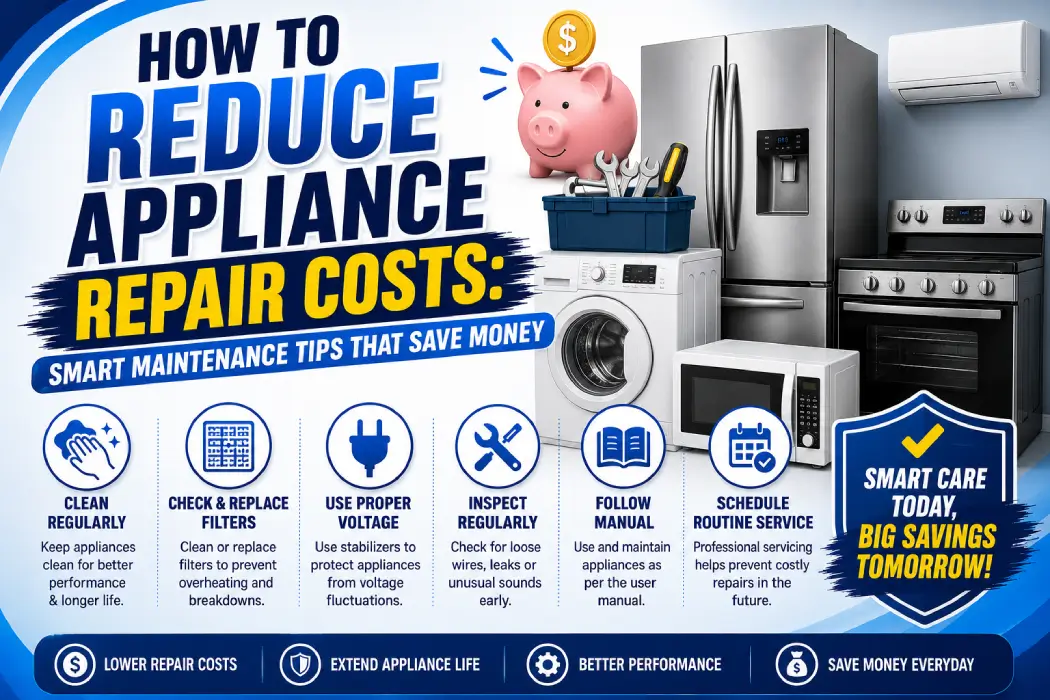
The best way to reduce appliance repair costs is to clean filters and ventilation areas, avoid overloading appliances, fix leaks early, protect electrical connections, follow the manufacturer’s instructions, and arrange professional service when performance changes. Early diagnosis usually costs less than repairing secondary damage caused by continued use.
Key Takeaways
- Do not ignore unusual noises, leaks, burning smells, error codes, or longer operating cycles.
- Clean filters, vents, seals, drains, and accessible coils before dirt causes overheating or restricted airflow.
- Avoid overloading washing machines, dryers, dishwashers, refrigerators, and electrical circuits.
- Use the correct detergent, operating mode, temperature, and load size.
- Keep repair records, model numbers, warranties, and service reports.
- Choose proper diagnosis instead of paying repeatedly for temporary fixes.
- Stop using any appliance that gives an electric shock, produces smoke, or repeatedly trips a breaker.
What Does Reducing Appliance Repair Costs Really Mean?
Reducing appliance repair costs means preventing avoidable damage and controlling the total amount spent throughout an appliance’s useful life. It includes routine cleaning, correct operation, early troubleshooting, timely professional repairs, lower energy waste, and informed repair-versus-replacement decisions.
The cheapest decision today is not always the least expensive decision long term. Delaying an AC capacitor replacement, for example, may place additional stress on the compressor. Continuing to use a noisy dryer may damage its motor or belt system. Good maintenance focuses on preventing this chain of secondary failures.
Why Appliance Repairs Become Expensive
Small Problems Are Ignored
Many major breakdowns begin with a minor symptom. A refrigerator may take longer to cool before the compressor stops starting. An AC may produce weak airflow before the evaporator coil freezes. A washing machine may drain slowly before the pump becomes fully blocked.
People often continue using the appliance because it still works. Unfortunately, the struggling component must operate longer or under greater pressure. Early inspection can reveal a dirty filter, loose connection, worn seal, blocked drain, or weak part before more costly components are affected.
Appliances Are Overloaded
Overloading creates mechanical and electrical strain. Too many clothes can place extra pressure on washing machine bearings, suspension parts, motors, and drive systems. A tightly packed dryer reduces airflow and increases drying time. An overcrowded refrigerator blocks internal circulation and makes temperature control less consistent.
Electrical circuits can also be overloaded when several high-power appliances share an unsuitable extension lead or outlet. Repeated breaker trips, hot plugs, and discoloured sockets require professional inspection rather than repeated resetting.
Maintenance Is Done Incorrectly
Maintenance can cause damage when the wrong chemicals, sharp tools, excessive water, or incorrect replacement parts are used. Spraying water directly around electrical controls, scraping ice with a knife, or cleaning an AC coil with excessive pressure may turn a manageable issue into an expensive failure.
Always follow the appliance manual. Generic online advice may not suit every brand, model, refrigerant type, filter design, or electronic control system. When access requires removing electrical panels, the task should be left to a qualified technician.
Temporary Repairs Replace Proper Diagnosis
Replacing a fuse, capacitor, thermostat, pump, or control board without identifying why it failed may only provide temporary relief. The original cause could be overheating, poor airflow, a voltage problem, water ingress, a blocked system, or another defective component.
A reliable technician should inspect the complete operating system rather than guess from one symptom. Correct diagnosis may cost slightly more at the first visit, but it reduces repeat call-outs, unnecessary parts, and damage to newly installed components.
Emergency Repairs Cost More Than Planned Service
An appliance that fails during peak demand can create additional losses beyond the repair bill. A broken refrigerator may spoil food. A failed restaurant chiller may affect stock. An AC breakdown may interrupt office work or leave a Bahrain home without cooling during very hot weather.
Planned maintenance allows faults to be handled before complete failure. It also gives property managers and businesses more control over scheduling, quotations, replacement parts, and downtime.
Warning Signs That Should Not Be Ignored
| Warning sign | Possible cause | Money-saving response |
|---|---|---|
| Appliance takes longer to complete its job | Restricted airflow, weak motor, blockage, sensor problem | Clean approved user-serviceable parts and arrange diagnosis if it continues |
| Unusual humming, grinding, clicking, or rattling | Worn bearing, loose part, motor, compressor, or obstruction | Stop repeated operation and book an inspection |
| Water under or inside the appliance | Blocked drain, damaged hose, pump, seal, or installation issue | Isolate water and power when safe, then repair the leak early |
| Burning smell or hot plug | Loose wiring, overloaded circuit, motor, heater, or terminal fault | Switch off immediately and call a professional |
| Higher electricity use | Dirty coils, poor seals, long cycles, incorrect settings, failing components | Compare operating patterns and service the appliance |
| Repeated error codes | Sensor, drainage, heating, motor, or control fault | Record the code and check the manual before booking service |
| Breaker repeatedly trips | Electrical fault, overload, short circuit, leakage, or damaged part | Do not keep resetting it; arrange electrical and appliance testing |
| Weak cooling or heating | Dirty filters, airflow restriction, thermostat, element, refrigerant, or compressor issue | Investigate before the appliance stops completely |
12 Smart Ways to Reduce Appliance Repair Costs
1. Respond to Changes Early
You know how your appliances normally sound and perform. Pay attention when an AC takes longer to cool, a refrigerator runs almost continuously, a washer becomes louder during spinning, or a dryer needs an extra cycle.
These changes do not always mean a major failure. They may indicate a blocked filter, incorrect load, dirty coil, loose part, worn seal, or early component weakness. Reporting the exact change helps a technician diagnose the problem before further damage develops.
2. Follow the Manufacturer’s Maintenance Instructions
The user manual should be your main maintenance guide. It explains which filters can be removed, which cleaning products are safe, how much clearance the appliance needs, and which error codes require professional service.
Keep a digital copy of the manual if the paper version is lost. Search using the exact model number rather than only the brand name. Two appliances from the same manufacturer may have different filters, reset procedures, cleaning requirements, and installation clearances.
3. Keep Filters and Airflow Paths Clean
Restricted airflow is a common cause of poor performance and overheating. AC filters, refrigerator ventilation spaces, dryer lint filters, dishwasher filters, and chiller strainers should be checked according to use and manufacturer guidance.
A blocked dryer lint filter increases drying time and reduces efficiency. ENERGY STAR recommends cleaning it after every load to maintain airflow and performance.
Cleaning visible filters is usually a safe owner task. Internal ducts, electrical compartments, condenser sections, and inaccessible blower assemblies should be serviced professionally.
4. Avoid Overloading
Overloading does not save time when the appliance must repeat a cycle or suffers premature wear. Washing machines need enough space for clothes to move. Dryers need airflow between items. Dishwashers need clear spray paths. Refrigerators need space for cold air circulation.
Follow the stated load capacity rather than estimating by whether more items can physically fit. Commercial properties should also avoid using domestic appliances beyond their intended operating duty. Heavy use may require commercial-grade equipment and a planned maintenance schedule.
5. Use the Correct Detergent and Consumables
Too much laundry detergent can create residue, odours, drainage problems, and excessive foam. Using regular washing-up liquid in a dishwasher can cause serious foaming and leakage. Incorrect descaling chemicals may damage seals, metals, and internal coatings.
Use products recommended for the appliance type and local water conditions. More detergent does not always mean better cleaning. Correct dosing protects pumps, hoses, heating components, sensors, and drainage systems while reducing the need for repeat cycles.
6. Fix Water Leaks Immediately
Water can damage flooring, cabinets, wiring, motors, control boards, and nearby appliances. Even a slow drip should be investigated. Look for cracked hoses, loose fittings, damaged door seals, blocked drains, overflowing trays, and AC condensate leaks.
Do not seal an unknown leak with tape and continue operating the appliance. A temporary patch may hide the symptom while water reaches electrical components. For recurring washer leaks, arrange professional washing machine repair in Bahrain. Dishwasher leaks should be handled through a qualified dishwasher repair service.
7. Protect Appliances From Electrical Problems
Loose sockets, damaged plugs, voltage instability, poor earthing, and overloaded circuits can damage appliance control boards, motors, compressors, and heating elements. Avoid running major appliances through cheap multi-plug adapters or unsuitable extension leads.
Bahrain’s Electricity and Water Authority advises customers to use EWA-approved contractors and requires periodic inspection of earthing systems and electrical breakers by approved professionals.
Electrical protection should match the appliance and installation. A surge protector cannot correct poor wiring, weak earthing, sustained voltage problems, or an overloaded circuit.
8. Give Appliances Enough Ventilation
Refrigerators, freezers, dryers, AC condensers, and electronic appliances produce heat during operation. Blocking ventilation openings traps this heat and makes internal components work harder.
Do not push a refrigerator tightly against a wall unless its installation guide allows it. Keep the outdoor condenser of a split AC free from stored objects and heavy debris. Avoid placing appliances beside strong heat sources where possible. Correct ventilation improves cooling, reduces operating time, and protects electrical components.
9. Clean Spills Before They Harden
Food, grease, detergent, and mineral deposits are easier to remove when they are fresh. Hardened deposits can block stove burner areas, dishwasher spray arms, door seals, steam iron holes, sensors, and drainage paths.
Disconnect the appliance where instructed and use non-abrasive cleaning methods approved by the manufacturer. Avoid pouring water into electric stove controls or using metal objects to clear small openings. Careful cleaning protects surfaces without pushing moisture or debris deeper into the appliance.
10. Keep Repair and Maintenance Records
Record the appliance model, purchase date, warranty period, repairs, installed parts, symptoms, and technician recommendations. Property managers should maintain a separate log for every AC, chiller, refrigerator, washer, and commercial appliance.
A repair history helps identify repeated faults. Two failed control boards or capacitors within a short period may point to an unresolved electrical, moisture, heat, or airflow problem. Records also prevent duplicate work and make repair-versus-replacement decisions more objective.
11. Use Qualified Technicians and Suitable Parts
A very cheap repair can become expensive when the diagnosis is wrong or unsuitable parts are installed. Ask what failed, why it failed, what part will be used, and whether the work includes testing and a service warranty.
Fix Bahrain’s appliance service pages state that repairs are diagnosed before work begins and cover homes and businesses across Bahrain, including Manama, Muharraq, Riffa, Isa Town, Hamad Town, Seef, and Juffair.
12. Schedule Preventive Maintenance for High-Use Equipment
Restaurants, offices, shops, villas, shared accommodation, and commercial properties often use appliances more heavily than a typical household. Waiting for breakdowns may not be the most economical maintenance strategy.
Plan inspections around operating hours and seasonal demand. AC and chiller systems should be checked before periods of heavy cooling use. Commercial refrigerators and dishwashers need regular cleaning and performance monitoring because failure can affect stock, hygiene, and business operations.
Appliance-Specific Maintenance Tips
Split and Central AC Systems
Clean accessible air filters regularly during heavy use. Watch for weak airflow, ice, dripping water, unusual compressor noise, burning smells, or longer cooling cycles. Dirty filters and coils can restrict heat transfer, while blocked condensate drains may cause water damage.
Do not assume every cooling problem needs an AC gas refill. Refrigerant does not normally disappear without a leak or system fault. A technician should inspect the evaporator coil, condenser, compressor, thermostat, fan motors, electrical components, and refrigerant pressures before recommending a solution.
For poor cooling, leaking water, or electrical faults, use professional AC repair in Bahrain.
Refrigerators and Freezers
Check that the door closes firmly and the gasket is clean. Keep ventilation openings clear and avoid placing hot food directly inside. Do not block internal air vents with tightly packed containers.
A refrigerator that runs continuously may have a damaged seal, dirty condenser area, incorrect temperature setting, airflow restriction, sensor fault, or cooling system problem. Clicking, weak cooling, water leakage, and excessive frost should be investigated before the compressor is damaged.
Book refrigerator repair in Bahrain when basic cleaning and loading adjustments do not restore normal performance.
Washing Machines
Check clothing pockets, distribute loads evenly, and avoid washing single heavy items without balancing them. Use the correct detergent and clean the accessible drain or pump filter according to the manual.
Do not ignore movement, banging, slow drainage, repeated filling, or water under the machine. These symptoms may involve levelling, suspension, bearings, hoses, pumps, valves, or drainage. Continuing to use a violently shaking washer can damage its drum, cabinet, wiring, and floor.
Qualified washing machine repair in Bahrain can prevent an early mechanical fault from becoming a full breakdown.
Dryers
Clean the lint filter after every load and keep the area around the dryer free from lint and clutter. Restricted airflow makes clothes take longer to dry and can increase heat inside the machine. ENERGY STAR identifies filter cleaning as an important efficiency and safety measure.
Do not repeatedly run extra cycles when drying time suddenly increases. The cause may be a blocked vent, overloaded drum, weak heating element, sensor fault, fan problem, or motor issue. Arrange dryer machine repair in Bahrain when cleaning the filter does not improve performance.
Dishwashers
Remove large food scraps before loading, position dishes so spray arms can rotate, and clean the filter as directed. Check the door seal for food residue and inspect the floor after each cycle for early signs of leakage.
Cloudy dishes, standing water, poor cleaning, unusual noise, or long cycles may indicate blocked spray arms, drainage issues, heater faults, pump problems, or incorrect detergent. Avoid using harsh drain chemicals inside the machine.
Professional dishwasher repair in Bahrain is recommended for internal leaks, electrical faults, repeated drainage errors, and heating problems.
Electric Stoves
Clean spills after the surface has cooled and follow the manufacturer’s care instructions. Use cookware that sits properly on the heating area and avoid allowing food or liquid to enter control openings.
A burner that heats unevenly, produces sparks, cycles incorrectly, or does not switch off may have an element, terminal, selector switch, thermostat, wiring, or control-board fault. Stop using any burner with a burning smell or visible damage.
Arrange safe electric stove repair in Bahrain instead of opening high-voltage components yourself.
Chiller AC Systems
Chiller systems need planned professional attention because a small control, water-flow, pressure, or electrical problem can affect an entire building or commercial operation. Maintain operating logs and watch for alarms, unusual pressure readings, rising temperatures, vibration, and increased energy use.
Filters, strainers, pumps, condenser surfaces, sensors, refrigerant circuits, controls, and electrical connections may all affect performance. Avoid repeatedly clearing alarms without investigating their cause.
Businesses and managed properties should schedule professional chiller AC repair in Bahrain before cooling performance becomes unstable.
Steam and Electric Irons
Use the type of water recommended by the manufacturer and descale only according to the manual. Empty stored water when required and keep the soleplate clean without using sharp metal tools.
Stop using an iron when its cord becomes hot, damaged, or intermittent. Other warning signs include sparking, water reaching electrical areas, poor temperature control, or an iron that remains hot after adjustment.
For thermostat, heating-element, cable, or steam faults, arrange iron repair in Bahrain.
Safe DIY Maintenance vs Professional Repair
| Task | DIY may be appropriate | Professional service required |
|---|---|---|
| Clean an accessible removable filter | Yes | No |
| Wipe door seals and visible surfaces | Yes | No |
| Check settings and error codes in the manual | Yes | No |
| Clear an accessible drain filter as instructed | Yes | Sometimes |
| Move stored objects away from ventilation areas | Yes | No |
| Open an electrical control panel | No | Yes |
| Test live voltage, earthing, or wiring | No | Yes |
| Repair refrigerant leaks or refill AC gas | No | Yes |
| Replace a compressor, motor, heater, or control board | No | Yes |
| Repair an appliance that shocks, sparks, or smokes | No | Yes |
| Replace breakers, sockets, or fixed wiring | No | EWA-approved contractor |
Step-by-Step Troubleshooting Before Booking a Repair
1. Stop and Observe
Identify exactly what changed. Note the sound, smell, error code, operating stage, temperature, leakage location, and whether the issue happens every time. Avoid repeatedly restarting an appliance that hums, overheats, trips a breaker, or smells burnt.
2. Make the Area Safe
Switch off and unplug the appliance when safe. Isolate the water supply if a washer or dishwasher is leaking. Keep people away from wet floors, hot plugs, damaged cables, and exposed electrical parts.
3. Check Simple External Causes
Confirm the appliance has power, the door is closed correctly, controls have not been changed, filters are clean, and the load is suitable. Check for blocked ventilation or a kinked external hose without removing protective covers.
4. Read the Manual
Look up the error code and troubleshooting section for the exact model. Some problems are caused by child locks, delayed-start settings, blocked user-serviceable filters, unbalanced loads, or incorrect operating modes.
5. Test Only When Safe
After correcting a simple issue, run one controlled test while remaining nearby. Stop immediately if the appliance leaks, sparks, overheats, produces a burning smell, or trips its breaker. Do not keep resetting or restarting it.
6. Record Useful Information
Take a clear picture of the model label, error code, damaged part, or leakage area. Write down when the problem started and whether recent installation, electrical, plumbing, or maintenance work occurred.
7. Book the Correct Professional
Use an appliance technician for internal mechanical, cooling, control, drainage, and heating faults. Use an EWA-approved electrical contractor when outlets heat up, fixed wiring is damaged, earthing is uncertain, or several appliances on one circuit are affected.
What Affects Appliance Repair Costs?
Repair costs depend on the appliance type, fault complexity, diagnostic time, part availability, brand, model, age, access, and extent of secondary damage. Inverter control boards, compressors, motors, and commercial cooling components generally require more specialised work than external hoses, seals, cords, or simple switches.
Emergency attendance, after-hours work, difficult installation access, and business downtime may also affect the total cost. A refrigerator built tightly into cabinetry or an outdoor AC unit in a restricted location may take longer to inspect safely.
Ask for a diagnosis and quotation before major repairs begin. The quotation should explain the failed component, labour, replacement part, warranty, and any additional work needed to correct the root cause.
Repair vs Replacement
| Repair may offer better value when | Replacement may offer better value when |
|---|---|
| The appliance is relatively young | The appliance is near the end of its practical life |
| The failure is limited to one part | Several major systems are damaged |
| Suitable replacement parts are available | Parts are discontinued or unreliable |
| The appliance was performing efficiently before the fault | Performance had already declined significantly |
| The repair includes a service warranty | The machine has repeated similar failures |
| The body, wiring, motor, or compressor remains sound | There is extensive rust, burnt wiring, or structural damage |
| The original cause can be corrected | The installation or design no longer meets the property’s needs |
Do not rely on a fixed percentage rule alone. Consider repair cost, appliance condition, replacement quality, installation changes, future electricity use, warranty coverage, and expected reliability.
A well-built older appliance with one replaceable part may be worth repairing. A newer but severely damaged appliance may not be. A professional assessment should explain both options without pressuring you toward the more expensive choice.
Common Mistakes That Increase Repair Costs
- Continuing to operate an appliance after it produces a burning smell.
- Resetting a tripping breaker several times.
- Adding refrigerant without locating an AC or refrigerator leak.
- Using oversized loads to reduce the number of washing or drying cycles.
- Ignoring small water leaks because the appliance still works.
- Using unsuitable detergents, descalers, or drain chemicals.
- Blocking refrigerator, dryer, AC, or chiller ventilation.
- Replacing parts based only on an online video.
- Choosing the lowest quotation without comparing diagnosis, parts, testing, and warranty.
- Failing to correct wiring, drainage, ventilation, or installation problems that caused the first failure.
Preventive Maintenance Schedule
| Frequency | Recommended checks |
|---|---|
| After every use | Remove dryer lint, check for leaks, wipe major spills, leave suitable appliances to dry |
| Weekly | Review unusual noises, cooling performance, drainage, door seals, cords, and visible hoses |
| Monthly | Clean user-accessible filters, inspect ventilation areas, check washer and dishwasher filters |
| Every three to six months | Review refrigerator ventilation, AC cleanliness, dryer airflow, hoses, seals, and operating times |
| Before peak cooling periods | Arrange AC or HVAC inspection where needed |
| Periodically | Have commercial refrigerators, chillers, high-use appliances, earthing, and breakers professionally inspected |
| After any repair | Keep the report, part details, quotation, and warranty information |
Maintenance frequency depends on the model, environment, and operating hours. A restaurant dishwasher or commercial refrigerator may need attention more often than a lightly used household appliance.
Real-Life Cost-Saving Scenarios
A Split AC With Weak Airflow
A homeowner notices the room taking longer to cool but waits until the AC stops. The technician then finds a heavily restricted filter, dirty coil, frozen evaporator section, and stressed fan motor.
Cleaning the filter and arranging early servicing could have reduced strain on the cooling system. Waiting transformed a maintenance issue into a repair involving more labour and possible component replacement.
A Washing Machine With a Small Leak
A washer develops a small drip near the front door. Towels are placed underneath, and the machine remains in use. Water eventually reaches the lower wiring and pump connection.
Replacing or cleaning the original seal would have been simpler. The final repair now includes the leak source, damaged connection, corrosion cleaning, and inspection of electrical components.
A Refrigerator That Runs Continuously
A refrigerator begins running for long periods, but it still keeps food reasonably cool. Several weeks later, cooling becomes weak and the compressor struggles to start.
The original problem may have been a poor door seal, blocked airflow, dirty ventilation area, or faulty fan. Early diagnosis could have reduced compressor workload and prevented food loss during a complete breakdown.
Expert Recommendations for Bahrain Properties
Bahrain homes and businesses often rely heavily on air conditioning and refrigeration. Dust, humidity, heat, coastal air, and long operating hours can expose weak seals, dirty coils, corroded connections, and airflow problems sooner than expected. Maintenance should reflect actual usage rather than a generic calendar.
Apartment residents should report building electrical, drainage, and central cooling problems early instead of treating them as appliance-only faults. Villa owners should maintain outdoor AC areas and review high electrical loads. Restaurants, shops, and property managers should keep written maintenance logs for cooling and kitchen equipment.
Avoid waiting for peak summer demand to inspect a struggling split AC, central AC, compressor, condenser, thermostat, or chiller cooling system. Planned HVAC maintenance gives you more control over appointments and prevents emergency decisions when cooling is urgently needed.
Final Preventive Maintenance Checklist
- Keep manuals and model numbers accessible.
- Check filters, seals, drains, vents, and hoses.
- Avoid overloading appliances and electrical outlets.
- Use approved detergents and cleaning products.
- Watch for changes in noise, operating time, temperature, and energy use.
- Repair water leaks before they reach electrical components.
- Never ignore shocks, sparks, smoke, or burning smells.
- Use EWA-approved contractors for fixed electrical work.
- Ask technicians to explain the cause, not only the failed part.
- Keep quotations, invoices, warranties, and repair reports.
- Compare repair and replacement based on long-term value.
- Schedule preventive service for heavily used and commercial equipment.
Conclusion
Understanding how to reduce appliance repair costs is mainly about timing. Cleaning a filter today is cheaper than replacing an overheated motor. Repairing a small leak is cheaper than replacing a damaged control board. Investigating weak cooling is cheaper than waiting for a compressor to fail completely.
Smart maintenance does not require advanced technical skills. It requires regular observation, safe cleaning, correct use, and knowing when to stop. DIY work should remain limited to tasks approved in the manufacturer’s manual. Electrical, refrigerant, internal wiring, heating, compressor, and control-board repairs belong with trained professionals.
Fix Bahrain supports homeowners, families, tenants, property managers, offices, restaurants, and commercial properties throughout Bahrain. Choose the relevant service for AC repair, refrigerator repair, washing machine repair, dryer repair, dishwasher repair, electric stove repair, chiller AC repair, or iron repair.
Frequently Asked Questions
1. What is the best way to reduce appliance repair costs?
The best approach is to combine correct daily use, routine cleaning, and early diagnosis. Keep filters and ventilation areas clear, avoid overloading, fix leaks quickly, and investigate changes in sound or performance. Follow the manufacturer’s maintenance instructions and use a qualified technician before a minor fault damages a motor, compressor, control board, or heating system.
2. Is preventive appliance maintenance actually worth the cost?
Preventive maintenance is most valuable for heavily used, cooling, heating, and commercial equipment. It can identify restricted airflow, loose connections, water leaks, worn parts, and abnormal temperatures before failure. Maintenance cannot prevent every breakdown, but it can reduce avoidable damage, unplanned downtime, food loss, and emergency repair decisions.
3. How often should home appliances be serviced?
There is no universal interval for every appliance. Frequency depends on the model, operating hours, environment, and manufacturer’s instructions. High-use AC units, chillers, commercial refrigerators, dryers, and restaurant equipment may need more frequent attention. Household users should complete regular visual checks and arrange professional service when performance changes or the manual recommends it.
4. Can cleaning an appliance prevent expensive repairs?
Yes, when cleaning protects airflow, drainage, seals, sensors, or heat transfer. Examples include cleaning AC filters, dryer lint filters, dishwasher filters, refrigerator seals, and accessible ventilation areas. However, cleaning cannot repair a failed motor, compressor, control board, electrical connection, refrigerant leak, or damaged bearing. Persistent symptoms still require diagnosis.
5. Should I repair an old appliance or buy a new one?
Consider the appliance’s age, condition, energy use, repair history, part availability, and replacement cost. Repair may be sensible when one replaceable part has failed and the rest of the appliance is sound. Replacement may offer better value when several major components are damaged, parts are unavailable, or the appliance has repeated safety and performance problems.
6. Why do the same appliance problems keep returning?
Repeat failures often mean the root cause was missed. A replaced control board may fail again because of moisture or voltage problems. An AC capacitor may repeatedly weaken because of heat or a struggling motor. Ask the technician to inspect related components, installation conditions, electrical supply, drainage, ventilation, and operating load before replacing another part.
7. Is it cheaper to repair an appliance myself?
Simple maintenance such as cleaning an approved filter or checking settings may save money. Internal DIY repair can increase costs when the wrong part is replaced or wiring, seals, panels, and refrigerant systems are damaged. It may also create shock, fire, flooding, or warranty risks. Limit DIY tasks to instructions provided by the manufacturer.
8. What appliance problems need immediate professional attention?
Stop using an appliance that produces smoke, sparks, a burning smell, electric shocks, a hot plug, major leakage, or repeated breaker trips. Immediate help is also recommended when a refrigerator stops cooling, an AC fails during extreme heat, or commercial cooling equipment threatens food or stock. Do not repeatedly restart equipment with serious warning signs.
9. How can property managers control appliance repair spending?
Keep an asset list with model numbers, installation dates, warranties, service history, and recurring faults. Schedule maintenance for high-use systems and request written diagnoses and quotations. Track which appliances create repeated call-outs. Standardising suitable models and parts may also simplify future maintenance across apartments, offices, shops, and managed properties.
10. Does energy-efficient operation reduce repair costs?
Efficient operation often reduces unnecessary runtime, heat, and mechanical strain. Correct settings, clean filters, good door seals, proper loads, and clear airflow help appliances complete their work without running longer than needed. Energy efficiency does not guarantee that parts will never fail, but poor efficiency can be an early warning of maintenance or component problems.