
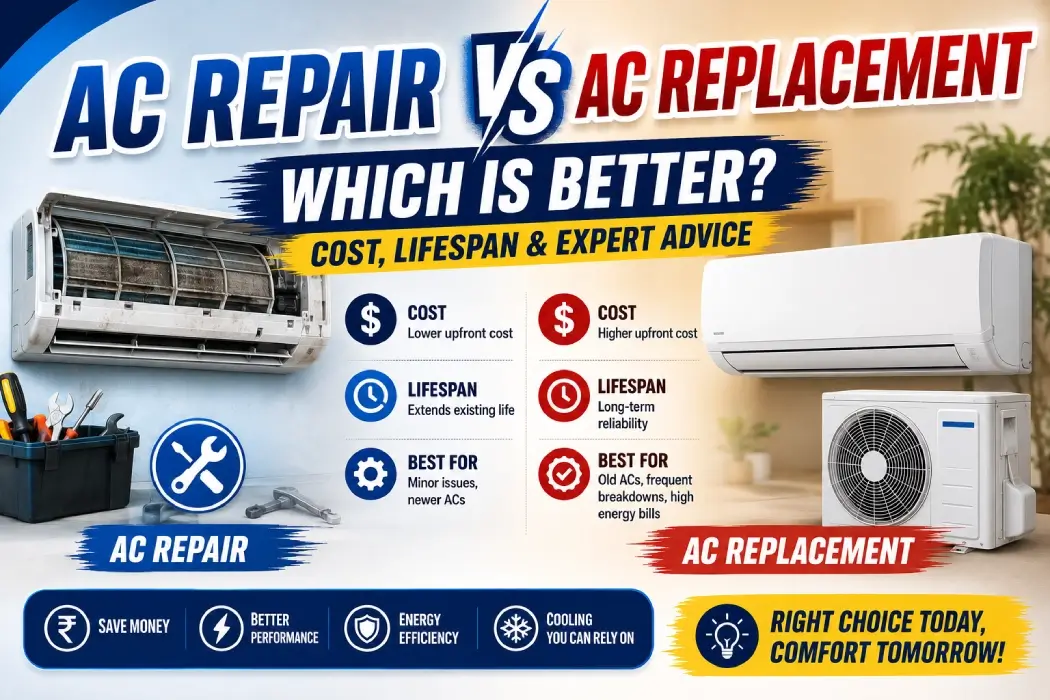
An air conditioner can lose cooling because of a dirty filter, weak capacitor, refrigerant leak, damaged fan motor, control-board fault, or failing compressor. Finding the fault is only part of the job. The bigger question is whether repairing the existing AC still makes financial and practical sense.
For homeowners, tenants, offices, restaurants, shops, and property managers in Bahrain, this decision matters because cooling systems often run for long hours. A sensible repair can extend useful life, but repeated repairs on an aging air conditioner can quietly cost more than a reliable, efficient replacement.
Quick Answer: Should You Repair or Replace Your AC?
Repair the air conditioner when it is relatively young, the fault is isolated, parts are available, and the work should restore reliable cooling. Consider replacement when the unit is over ten years old, breaks down repeatedly, uses excessive electricity, performs poorly, or needs a major component such as a compressor.
What Does “AC Repair vs AC Replacement” Mean?
AC repair keeps the existing cooling system and corrects a specific problem, such as replacing a capacitor, clearing a drain, repairing wiring, cleaning coils, sealing a refrigerant leak, or changing a fan motor. AC replacement removes the old unit and installs a new, correctly sized system.
The right AC investment decision is not based on age alone. A technician should consider condition, repair history, energy efficiency, cooling performance, refrigerant type, installation quality, spare-part availability, and how damaging unexpected cooling downtime would be for the property.
AC Repair vs AC Replacement Comparison
| Decision factor | Repair is usually better when | Replacement is usually better when |
|---|---|---|
| AC age | The unit remains within useful service life | The unit is old and near the end of its life |
| Fault | Capacitor, thermostat, drain, sensor, or fan issue | Compressor failure, severe corrosion, or several major faults |
| Repair history | First breakdown or occasional minor work | Frequent breakdowns and repeated service calls |
| Performance | Full cooling should return after repair | Rooms stay warm, humid, noisy, or uneven |
| Electricity use | Consumption remains stable | Consumption rises while comfort declines |
| Parts | Suitable parts are readily available | Parts are discontinued, delayed, or costly |
| Property need | Low-use or non-critical room | Family home, office, restaurant, shop, or server space |
How Long Does an Air Conditioner Last?
There is no single air conditioner lifespan for every Split AC, Inverter AC, Window AC, or central system. Installation quality, daily runtime, sizing, maintenance, indoor heat load, refrigerant condition, airflow, and exposure around the outdoor condenser all affect how long the equipment remains reliable.
ENERGY STAR recommends professional evaluation when an air conditioner is more than ten years old, particularly when comfort is poor, repairs are frequent, or energy bills are increasing. Ten years is not an automatic expiry date, but age should carry more weight when a major repair is proposed.
Bahrain’s heat, humidity, dust, coastal conditions, and long cooling seasons can place additional stress on coils, compressors, drains, fan motors, capacitors, and electrical components. Preventive maintenance is therefore important for apartments, villas, offices, restaurants, shops, and commercial properties.
Signs Your AC Is Worth Repairing
The AC Is Relatively New
A newer system normally deserves repair when its compressor, coils, and refrigeration circuit remain healthy. Replacing a complete unit because of a failed capacitor, thermostat, sensor, contactor, drain, or fan motor usually wastes equipment that still has useful life.
This Is the First Significant Breakdown
One failure does not prove the cooling system is unreliable. Electrical parts can fail through wear, heat, voltage conditions, or manufacturing defects. When the unit has a clean service history and good previous cooling performance, a targeted repair may restore dependable operation.
The Fault Is Minor and Clearly Diagnosed
Common repairable problems include dirty filters, blocked drain lines, loose electrical connections, failed capacitors, damaged thermostats, faulty temperature sensors, and worn fan motors. These problems can seriously reduce cooling without showing that the compressor or entire air conditioner needs replacement.
Cooling Was Good Before the Fault
If the room cooled evenly, humidity felt controlled, noise was normal, and electricity consumption was reasonable before the breakdown, repair is usually worth considering. Good previous performance suggests the system may still provide useful service after the exact failed component is corrected.
Signs AC Replacement Is the Better Choice
The Unit Is Over Ten Years Old
Age changes the repair calculation. A minor old AC repair may still be sensible, but compressor, coil, or control-board work should be compared with expected remaining life, energy efficiency, parts support, warranty, and the possibility that another aging component will fail soon.
Repairs Are Becoming Frequent
Recurring gas refills, capacitor failures, fan problems, drain blockages, sensor errors, and control-board faults indicate declining reliability. Each invoice may look manageable, yet the combined repair cost, inconvenience, emergency calls, and lost cooling can make replacement the better long-term choice.
The Compressor Has Failed
The compressor is the heart of the cooling system and one of its costliest components. Replacement may be worthwhile on a newer, high-quality unit with healthy coils. On an aging system, spending heavily on the compressor is risky because other components have the same age and wear.
The Coils Leak or Show Serious Corrosion
Refrigerant circulates inside a sealed system. Low refrigerant normally indicates leakage or incorrect previous service, not routine “gas consumption.” Multiple leaks, inaccessible damage, or widespread corrosion can make replacement more dependable than repeated patching, refilling, and cooling loss.
Electricity Use Rises While Comfort Falls
Higher consumption can result from dirty coils, low airflow, incorrect refrigerant charge, duct problems, or worn components, so diagnosis must come first. When servicing cannot restore acceptable efficiency and the AC runs for long periods without cooling properly, an upgrade becomes more attractive.
Parts or Refrigerant Support Is Poor
Some older systems become difficult to support because specific motors, boards, coils, or controls are unavailable or expensive. Ask the technician to confirm the model, refrigerant, repair lead time, compatible parts, and likely future service risks before approving major work.
Repair Costs vs Replacement Costs: What Changes the Price?
There is no honest universal price for AC repair or replacement. Cost depends on system type, brand, capacity, fault, access, parts, refrigerant, labour, installation materials, drainage, electrical work, ducting, emergency timing, and whether hidden damage appears during testing.
For a diagnosis and quotation, use Fix Bahrain’s AC repair service in Bahrain. The service page covers Split AC, Window AC, central, cassette, and ducted systems, including cooling faults, compressors, gas refilling, water leakage, thermostats, and fan motors.
A repair quote may cover diagnosis, parts, labour, cleaning, leak testing, refrigerant work, final performance checks, and warranty. A replacement quote may cover equipment, removal, brackets, piping, insulation, drainage, cabling, electrical upgrades, commissioning, duct changes, and manufacturer or installation warranties.
Compare the full scope rather than the equipment price alone. Poor sizing, leaking pipework, damaged insulation, weak drainage, incorrect refrigerant charge, or bad electrical connections can make a new air conditioner inefficient and unreliable from its first season.
A Practical Repair-or-Replace Method
A simple percentage rule can be misleading. A better decision considers age, exact fault, recent repair spending, electricity consumption, comfort, remaining life, warranty, and downtime. Use these steps before committing to a major repair or a new cooling system.
- Confirm the exact fault. Similar symptoms can have very different causes.
- Check age and condition. Inspect coils, compressor, fans, wiring, and controls.
- Review repair history. Add service costs from the last two years.
- Assess performance. Note runtime, noise, humidity, and uneven cooling.
- Compare future risk. Ask which components may fail next.
- Compare warranties. Review repair coverage against new-system protection.
- Value downtime. Lost cooling matters more in homes and commercial properties.
Symptoms and Recommended Action
| Symptom | Possible cause | Recommended action |
|---|---|---|
| AC runs but does not cool | Dirty filter, coil, low refrigerant, or compressor fault | Check airflow, then request diagnosis |
| Unit starts and stops quickly | Thermostat, capacitor, airflow, sizing, or control issue | Arrange electrical and airflow testing |
| Water leaks indoors | Blocked drain, damaged tray, poor slope, or frozen coil | Stop severe leakage and repair the cause |
| Outdoor unit does not start | Capacitor, contactor, PCB, wiring, or compressor | Professional electrical testing |
| Ice forms on pipe or coil | Low airflow, low refrigerant, or blower fault | Turn cooling off and book service |
| Burning smell or sparks | Overheated wiring, motor, capacitor, or PCB | Isolate power immediately |
| Frequent gas refills | Refrigerant leak | Find and assess the leak |
| High electricity use | Dirt, long runtime, poor efficiency, or sizing issue | Service first, then compare upgrades |
Step-by-Step Troubleshooting Before Deciding
Basic checks can prevent an unnecessary call, but they should not involve opening electrical panels, touching moving parts, bypassing safety controls, or handling refrigerant. Stop immediately if you smell burning, see sparks, notice melted wiring, hear severe mechanical noise, or find water reaching electrical parts.
1. Confirm the Thermostat
Set the thermostat to cooling mode and choose a temperature below the room temperature. Check the fan setting, display, batteries, and error codes. A wrong mode or weak battery can look like a larger cooling fault.
2. Check the Power Supply
Look for a tripped breaker or switched-off isolator. Reset a breaker only once. If it trips again, leave it off. Repeated resetting can increase risk and damage, while the underlying wiring, motor, compressor, or control fault remains unresolved.
3. Inspect the Filter
A dirty filter restricts airflow and makes the system work harder. ENERGY STAR recommends monthly checks during heavy use and cleaning or replacement when dirty. Clean airflow also protects coils and reduces the chance of early equipment failure.
4. Check Vents and Airflow
Make sure curtains, furniture, dust, or closed grilles are not blocking airflow. Persistent weak airflow can indicate a dirty evaporator coil, frozen coil, blower fault, duct restriction, or incorrect fan speed that requires professional measurement.
5. Look for Water or Ice
Indoor water may come from a blocked condensate drain, damaged tray, incorrect slope, or frozen coil. Ice can indicate restricted airflow or refrigerant trouble. Turn cooling off and let the ice melt before professional inspection.
6. Observe the Outdoor Unit Safely
From a safe distance, check whether the condenser fan runs and whether debris blocks airflow. Do not remove the cover. The cabinet contains high-voltage parts, a capacitor that may retain charge, hot piping, and moving fan blades.
7. Review the Unit’s History
Collect previous invoices, model details, installation date, electricity bills, and notes about recurring faults. This helps the technician make a complete repair-or-replace recommendation rather than treating every failure as an unrelated event.
DIY vs Professional AC Work
| Task | Reasonable DIY check | Professional work |
|---|---|---|
| Filter | Clean or replace an accessible filter | Diagnose recurring dirt or airflow loss |
| Thermostat | Check settings and batteries | Repair controls, wiring, sensors, or calibration |
| Vents | Remove visible obstruction | Measure blower and duct airflow |
| Drain | Wipe minor external moisture | Clear internal blockage or repair tray and slope |
| Outdoor area | Remove nearby debris after isolating power | Open cabinet, clean internally, or test components |
| Refrigerant | No DIY work | Detect leaks, recover, vacuum, and charge |
| Electrical system | Reset breaker once | Test capacitor, PCB, contactor, motor, and wiring |
What a Professional Technician Should Test
A trustworthy technician should test before replacing parts. Depending on the fault, this may include voltage and current measurements, capacitor testing, thermostat checks, temperature-split readings, airflow assessment, drain inspection, refrigerant-pressure analysis, leak detection, coil inspection, compressor testing, and control-board diagnostics.
The recommendation may involve a targeted repair, deep cleaning, leak repair, component replacement, airflow correction, duct improvement, or upgrade. Commercial facilities and large cooling systems can also use Fix Bahrain’s chiller AC repair service.
AC Upgrade Benefits
A suitable new AC can offer lower electricity consumption, quieter operation, better temperature control, improved humidity management, modern controls, easier parts support, and stronger warranty protection. These benefits depend on proper sizing and installation; the largest or cheapest unit is not automatically the best choice.
An Inverter AC adjusts compressor output as cooling demand changes instead of operating only at full output and stopping repeatedly. This can improve part-load efficiency and comfort, but the model must suit room size, insulation, windows, occupancy, equipment heat, and operating hours.
Questions to Ask Before Buying
- What cooling capacity does the space actually need?
- Is the system suitable for Bahrain’s climate and expected runtime?
- What energy-efficiency rating applies?
- Are the indoor and outdoor components correctly matched?
- Are piping, insulation, drainage, brackets, and cabling included?
- Will the old refrigerant lines be tested or replaced?
- What are the equipment and installation warranties?
- How will the installer commission and verify performance?
- Are spare parts and qualified local service available?
Common Mistakes
Refilling Refrigerant Without Finding the Leak
Low refrigerant is a symptom. Adding gas without locating the leak can create a short improvement while the fault continues. Request leak detection, repair options, and an explanation of whether the damaged coil or pipe is economically worth fixing.
Replacing the AC Without Diagnosis
Poor cooling does not automatically mean compressor failure. A dirty filter, blocked condenser, weak capacitor, faulty thermostat, fan issue, or control problem can create similar symptoms. Diagnosis protects you from replacing equipment that only needed a manageable repair.
Repeatedly Repairing an Unreliable Old Unit
Add the full repair history, downtime, electricity use, and likely future failures. Several “small” repairs can exceed the value of replacement while leaving you with the same old compressor, coils, wiring, fans, and controls.
Choosing a New Unit Only by Price or Capacity
An oversized AC may short cycle and manage humidity poorly. An undersized system may run continuously without reaching the set temperature. Correct load assessment, efficient equipment, reliable parts support, and installation quality matter more than simply buying the largest capacity.
Safety Precautions
Turn the AC off at the isolator or breaker when there is smoke, burning smell, sparking, severe vibration, repeated breaker tripping, exposed wiring, or water near electrical components. Continuing to run the unit can increase fire, shock, motor, control-board, or compressor damage.
Do not open capacitor compartments, bridge wires, force fan blades, bypass thermostats, or attempt refrigerant work. Capacitors may remain dangerous after disconnection, while refrigerant systems require trained handling, pressure control, recovery equipment, leak testing, and correct charging procedures.
Preventive Maintenance Checklist
| Frequency | Maintenance task |
|---|---|
| Monthly during heavy use | Check the filter, airflow, noise, smell, water, and thermostat |
| Every few months | Clean reusable filters and keep the outdoor area clear |
| Before peak summer | Arrange coil, drain, electrical, refrigerant, and performance checks |
| After construction or dusty work | Inspect filters and coils earlier |
| After any repair | Confirm cooling, drainage, noise, stability, and warranty |
| Annually | Review repair history, comfort, consumption, and system suitability |
Professional maintenance should include evaporator and condenser coils, condensate drainage, refrigerant condition, controls, blower components, and starting and stopping operation. ENERGY STAR notes that dirty coils, incorrect refrigerant levels, and poor airflow can raise operating costs and shorten equipment life.
Expert Recommendations by Situation
Five-Year-Old Split AC in an Apartment
Repair is usually the stronger option when previous cooling was good and the fault is a capacitor, fan motor, thermostat, sensor, drain blockage, or service issue. Ask the technician to confirm coil condition, refrigerant tightness, compressor health, and electrical stability.
Villa With Several Old AC Units
Do not automatically replace every system together. Create a phased plan based on age, room priority, repair history, efficiency, corrosion, and condition. Replace the weakest units first while maintaining those that remain dependable and economical.
Restaurant, Shop, or Office
Downtime has a direct business cost. Repair works when parts are available and expected remaining life is strong. Replacement may be better when repeated breakdowns affect customers, staff, products, sensitive equipment, or normal opening hours.
Key Takeaways
- Repair younger, reliable systems with isolated faults.
- Consider replacement when age, major failure, high consumption, and repeated breakdowns combine.
- Never accept repeated gas refills without leak assessment.
- Compare total ownership cost, not only today’s invoice.
- Correct sizing and installation determine upgrade results.
- Maintain filters, coils, drainage, controls, and airflow.
- Request a written diagnosis and quotation before deciding.
Related Fix Bahrain Services
Fix Bahrain also provides refrigerator repair, washing machine repair, dryer repair, dishwasher repair, electric stove repair, and steam iron repair.
Suggested AC cluster articles include AC Not Cooling, AC Water Leakage, AC Gas Refill, AC Maintenance Guide, and AC Compressor Problems. Link each guide back with a descriptive anchor related to deciding whether to repair or replace an AC.
Frequently Asked Questions
Is It Better to Repair or Replace an Old AC?
Repair can be worthwhile when the fault is minor, coils are healthy, previous performance was good, parts are available, and breakdowns are rare. Replacement becomes stronger when the unit is over ten years old, needs a major compressor or coil repair, consumes too much electricity, and has become unreliable.
At What Age Should I Replace My Air Conditioner?
There is no fixed expiry date, but ten years is a useful point for deeper assessment. Consider condition, maintenance, usage, efficiency, refrigerant, repair history, and parts availability. A maintained unit may continue working, while a younger AC with poor installation or severe corrosion may need earlier replacement.
Is Compressor Replacement Worth It?
It may be worthwhile on a newer, valuable system when the evaporator coil, condenser coil, controls, fan motors, and refrigerant circuit remain healthy. It is harder to justify on an aging AC with corrosion, repeated faults, poor efficiency, or scarce parts because another expensive failure may follow.
Why Does My AC Need Gas Again?
An AC does not normally consume refrigerant like fuel. Low refrigerant usually means leakage, incorrect charging, or previous work on the sealed circuit. Ask for leak detection and a repair assessment before paying for another refill that may provide only temporary cooling.
Will a New Inverter AC Reduce My Electricity Bill?
A correctly sized and installed Inverter AC can operate more efficiently as cooling demand changes. Actual savings depend on the old unit, insulation, room heat load, set temperature, maintenance, occupancy, operating hours, equipment efficiency, and installation quality.
Can a Dirty AC Look Like It Needs Replacement?
Yes. Dirty filters, coils, blowers, and restricted airflow can reduce cooling, increase runtime, create ice, and raise electricity use. Service and test performance before deciding. Cleaning will not, however, solve a failed compressor, leaking coil, or damaged control board.
Should I Repair a Leaking AC Coil?
A small, accessible leak may be repairable, depending on coil material, location, corrosion, refrigerant, and unit age. Replacement may be better when there are multiple leaks, widespread corrosion, weak parts support, or a repair cost that is difficult to justify.
How Do I Compare Repair and Replacement Quotes?
For repair, request the diagnosis, parts, labour, refrigerant work, warranty, and total price. For replacement, confirm model, capacity, efficiency, pipework, insulation, drainage, electrical work, removal, commissioning, and warranties. Compare expected reliability and running cost, not only the lowest upfront quote.
Is AC Replacement Always More Energy-Efficient?
A modern system may be more efficient, but results depend on sizing, matched components, correct refrigerant charge, airflow, clean coils, controls, and installation. A badly installed high-efficiency unit can underperform, while a maintained existing system may still provide acceptable value.
Who Should Make the Final Repair-or-Replace Decision?
The property owner or responsible manager should decide after receiving a clear diagnosis from a qualified technician. The technician should explain the fault, safety concerns, repair cost, expected remaining life, warranty, efficiency, and replacement scope without pushing the customer toward the most expensive option.
Final Verdict
Choose AC repair when the system is reasonably young, dependable, efficient enough, and affected by a clear repairable fault. Choose replacement when advanced age, repeated breakdowns, major component failure, poor comfort, rising consumption, corrosion, and weak parts support appear together.
For a clear recommendation, book Fix Bahrain’s AC repair service across Bahrain. A technician can inspect the system, explain both options, and help you make a practical decision for a home, apartment, villa, office, restaurant, shop, or managed property.