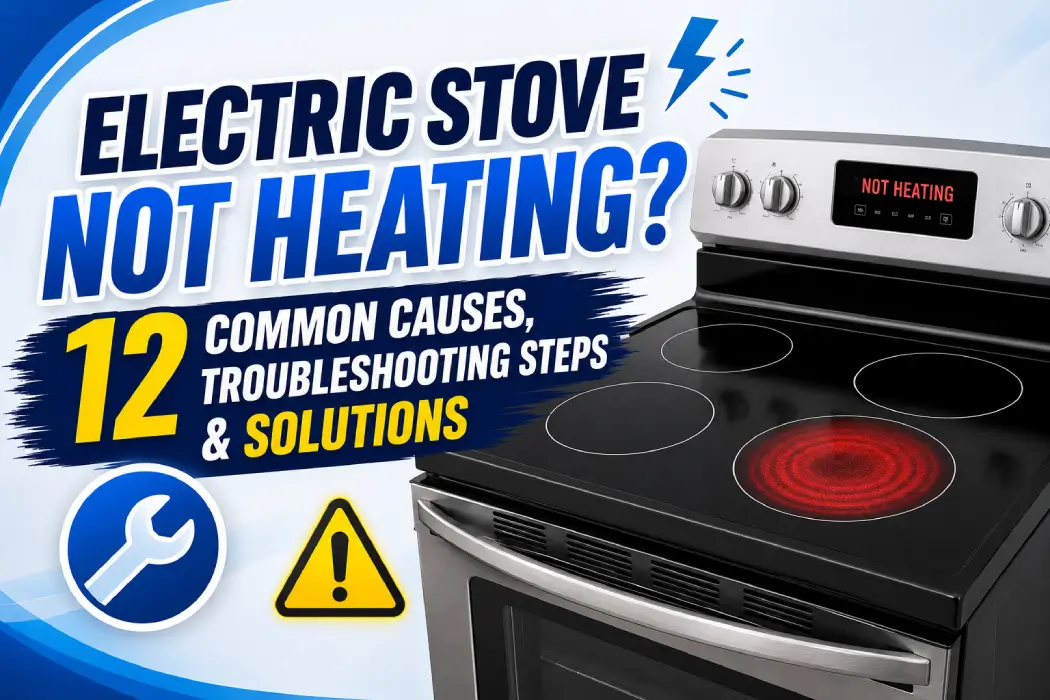
There’s nothing quite as inconvenient as standing over a stove that should be simmering dinner while the burner sits there, stubbornly cold. Maybe the display lights up fine, maybe you can even hear a faint click, but no heat is coming through. Before assuming the worst, it helps to know that this is one of the more common calls appliance technicians get, and most causes are specific and fixable.
This guide covers the 12 most common reasons an electric stove stops heating, how to tell them apart, what’s safe to check yourself, and when it’s time to call a certified technician instead of guessing at the cause.
Quick Answer
An electric stove usually stops heating due to a faulty heating element, a tripped breaker, a damaged power cord, a failed control switch, or loose wiring connections. In Bahrain homes, older wiring and worn heating elements from years of daily use are especially common causes, particularly in units over 8 years old.
Why Electric Stoves Stop Heating
Electric stoves rely on a fairly simple chain of components: power comes in through the cord, passes through switches and control boards, and reaches the heating elements, which convert electricity into the heat used for cooking. A fault anywhere along that chain, from a worn element to a loose connection, can stop heat from reaching the burner.
In Bahrain, electric stoves see heavy daily use across homes, restaurants, and shops, often multiple times a day for years without a break. That kind of continuous cycling wears down heating elements and switches faster than occasional use would, which is why stoves used in commercial kitchens tend to need element replacement more frequently than typical household units.
1. Faulty or Burned-Out Heating Element
This is the single most common cause of a single burner not heating. Over time, the metal coil inside the element weakens and eventually burns through, cutting off the circuit entirely, even though power is still reaching the stove.
Symptoms: One specific burner not heating while others work fine, visible cracks, blistering, or discoloration on the element’s surface, no glowing red color when the burner is switched on.
What to do: If a coil element looks visibly damaged or the connection points appear burnt, it’s usually a straightforward replacement. Coil elements are generally simple to swap, but this should still be done with the power disconnected and ideally by a technician if you’re unfamiliar with the process.
2. Tripped Circuit Breaker
Sometimes the stove itself is perfectly fine, but the breaker feeding it has tripped, cutting power completely. This can happen after a power surge, an overloaded circuit, or a fault elsewhere in the home’s electrical system.
Symptoms: Entire stove not heating at all, including the display or indicator lights, other appliances on the same circuit also without power.
What to do: Check your home’s electrical panel and reset the breaker if it’s tripped. If it trips again shortly after resetting, that indicates an underlying electrical fault that needs a certified technician to diagnose.
3. Damaged Power Cord or Plug
A frayed, cracked, or loose power cord can prevent consistent electricity from reaching the stove, especially on older units or ones that have been moved or cleaned around frequently.
Symptoms: Stove flickering on and off intermittently, burning smell near the plug or cord, visible fraying or scorch marks on the cord itself.
A damaged cord is a genuine fire and shock hazard. Never attempt to tape over or patch a frayed cord, it needs to be replaced entirely by someone qualified to handle the electrical connection safely.
4. Faulty Control Switch or Knob
Each burner typically has its own control switch that regulates power flow and heat level. If this switch fails internally, the burner may not receive any power at all, regardless of how the dial is set.
Symptoms: Burner not responding at any heat setting, knob feels loose or doesn’t click into position properly, other burners on the same stove working normally.
5. Loose or Corroded Wiring Connections
Internal wiring connections can loosen over years of use, vibration, and heat cycling. Corrosion can also build up on connection points, especially in humid environments, reducing how effectively electricity passes through.
Symptoms: Intermittent heating that comes and goes, burner working after being adjusted or bumped, inconsistent performance that seems to change without a clear pattern.
Wiring issues should never be investigated by removing stove panels yourself. This involves exposed electrical components and is strictly a job for a certified technician.
6. Failed Infinite Switch (For Coil and Solid Element Stoves)
The infinite switch controls how much power cycles to the element based on your heat setting. When it fails, the burner might not heat at all, or might only work on specific settings rather than the full range.
Symptoms: Burner works on high but not low (or vice versa), heat level doesn’t seem to match the dial position, clicking sound from the switch without corresponding heat.
7. Blown Fuse (In Models With Internal Fuses)
Some electric stoves, particularly certain built-in and commercial models, use internal fuses to protect specific circuits. A blown fuse can cut power to one or more burners while leaving others functional.
Symptoms: Specific burners or the oven not heating while others work, no visible damage to the element itself, display and other stove functions working normally.
8. Faulty Control Board (In Digital/Touch Models)
Modern electric stoves with digital displays and touch controls rely on a control board to manage power distribution to each element. A failing board can cause one or multiple burners to stop responding.
Symptoms: Touch controls unresponsive or behaving erratically, display showing error codes, burners not heating despite correct settings being selected.
Control board issues require specialized diagnostic knowledge and are not a DIY repair. Attempting to troubleshoot digital control systems without proper training risks further damage to the board.
9. Incorrect or Incompatible Cookware (Induction Stoves)
For induction stoves specifically, cookware compatibility matters more than most people realize. If a pot or pan isn’t magnetic, the burner simply won’t generate heat, regardless of how correctly everything else is functioning.
Symptoms: Burner shows an error or won’t activate with certain cookware, works fine with other pots and pans, display indicates a compatibility issue if the model has one.
What to do: Use a magnet to test cookware, if it sticks firmly to the base, it should work on an induction burner. Stainless steel and cast iron generally work well; aluminum, copper, and glass typically do not.
10. Overheating Protection Triggered
Many electric stoves have built-in safety features that shut off a burner if it senses overheating or a fault, protecting both the appliance and the household from a genuine hazard.
Symptoms: Burner suddenly stops mid-use, won’t restart immediately after shutting off, resumes working after cooling down for a period of time.
If this happens repeatedly, it usually indicates an underlying issue, not just a one-time safety trigger, and is worth having checked rather than dismissed as unusual.
11. Voltage Supply Issues
Electric stoves, particularly larger models or commercial units, need consistent voltage to heat properly. Fluctuating or insufficient voltage from the home’s electrical supply can prevent elements from reaching full temperature.
Symptoms: Burners heating weakly rather than not at all, performance varying depending on what else is running in the home, dimming lights elsewhere when the stove is in use.
12. Aging Unit Nearing End of Lifespan
Most electric stoves perform reliably for 10 to 15 years with reasonable care. Past that point, elements, switches, and wiring components tend to wear down together, and heating performance can decline even without one single obvious cause.
Symptoms: Multiple element replacements over the past year or two, inconsistent heating across several burners, overall performance noticeably weaker than when the unit was new.
Step-by-Step Troubleshooting Before Calling a Technician
- Check whether the issue affects one burner or the entire stove, this narrows down the likely cause significantly.
- Inspect the affected element for visible cracks, blistering, or burn marks.
- Check your home’s circuit breaker to confirm the stove is receiving power.
- Test the same burner setting on a different burner to compare heating response.
- Inspect the power cord and plug for fraying, scorch marks, or looseness.
- For induction stoves, confirm your cookware is magnetic and compatible.
- Note whether the problem is constant or intermittent, and whether it correlates with specific heat settings.
If the stove still isn’t heating properly after these checks, it’s time to call a professional rather than continuing to test electrical components yourself.
DIY vs Professional Repair
| Task | DIY Appropriate | Professional Required |
|---|---|---|
| Checking breaker and resetting | Yes | — |
| Visual inspection of heating element | Yes | — |
| Testing cookware compatibility (induction) | Yes | — |
| Cleaning around burners and connections | Yes | — |
| Replacing a coil heating element | Sometimes | Recommended if unfamiliar |
| Power cord replacement | No | Yes |
| Wiring or connection repair | No | Yes |
| Control board diagnosis/repair | No | Yes |
| Infinite switch or fuse replacement | No | Yes |
Common Mistakes Homeowners Make
- Continuing to use a burner with a visibly cracked or damaged element.
- Ignoring a burning smell near the cord or plug instead of treating it urgently.
- Resetting a tripped breaker repeatedly without investigating why it keeps tripping.
- Assuming induction cookware issues are a stove malfunction rather than a compatibility problem.
- Attempting to open the stove’s back panel or control board without proper training.
- Delaying repair for months while relying on fewer working burners.
Safety Precautions
Always switch off the stove at the breaker before inspecting elements, cords, or connections. Never touch a heating element to check if it’s working, visual inspection is enough to spot damage. If you notice sparking, a burning smell, or scorch marks anywhere near the stove, disconnect power immediately and contact a certified technician rather than continuing to use it.
What Affects Repair Cost
Electric stove repair costs vary based on a few genuine factors rather than a flat rate:
- Type of issue – a coil element replacement is generally far less expensive than control board repair.
- Stove type – digital touch-control and induction models often involve more complex components than standard coil stoves.
- Age of the unit – older stoves may need parts that take longer to source.
- Commercial vs residential use – commercial kitchen stoves often see heavier daily use, which can affect wear patterns and repair frequency.
A proper diagnosis before repair work means you know exactly what’s being fixed and why, rather than replacing parts based on guesswork.
Repair vs Replacement Guidance
If your stove is under 8 years old and the issue is isolated, a single element, a switch, or a cord, repair is almost always the more practical choice. If the unit is past 10-12 years old, has needed multiple repairs recently, or requires control board replacement, it’s worth comparing that cost against a new, more energy-efficient model.
Preventive Maintenance Checklist
- Clean spills and food residue from burners and control panels regularly to prevent buildup around connections.
- Inspect the power cord periodically for fraying or looseness.
- Avoid using excessive force on knobs and switches, treat them gently even under daily heavy use.
- Have wiring and connections professionally inspected every couple of years, especially for units over 8 years old.
- For induction stoves, use only compatible magnetic cookware to avoid unnecessary error triggers.
- Address a single malfunctioning burner promptly rather than waiting until multiple burners fail.
When to Call a Certified Technician
If you’ve checked the breaker, inspected the element, and confirmed the cord is intact but the stove still isn’t heating, it’s time to bring in a professional. Wiring faults, control board issues, and switch failures all require proper diagnostic tools and training to repair safely. Fix Bahrain’s electric stove repair service in Bahrain covers diagnosis, element replacement, wiring repair, and full servicing for homes, restaurants, and commercial kitchens.
Related Reading
If your stove has other issues beyond heating problems, these related guides may help:
- Electric Stove Burner Problems: Warning Signs to Watch
And if it’s a different appliance giving you trouble, Fix Bahrain also handles AC repair, refrigerator repair, washing machine repair, dryer repair, dishwasher repair, chiller AC repair, and iron repair across Bahrain.
Conclusion
An electric stove that’s not heating is rarely a total mystery once you know what to check. Most cases trace back to a handful of causes: a burned-out element, a tripped breaker, a damaged cord, or a failing switch. Many of these are straightforward for a technician to diagnose quickly, and a few are even safe to check yourself before calling for help.
If your stove still isn’t heating after checking the basics, don’t keep pushing through with fewer working burners. Reach out to Fix Bahrain’s electric stove repair team for fast, reliable service across Manama, Riffa, Muharraq, Isa Town, Hamad Town, and the rest of Bahrain.
Frequently Asked Questions
Why is only one burner on my electric stove not heating?
This usually points to a burned-out heating element or a faulty control switch for that specific burner. Since the other burners work fine, the issue is isolated rather than a stove-wide electrical fault, which typically makes it a simpler, more affordable repair.
Why does my stove display light up but the burners won’t heat?
This suggests the power supply to the stove is working, but something further along the circuit, a switch, element, or internal wiring, isn’t functioning. It’s rarely a full stove failure and usually narrows down to one specific faulty component.
Is it safe to keep using a stove with a cracked heating element?
No. A cracked or visibly damaged element is a safety risk and can potentially cause sparking or electrical faults. It’s best to stop using that burner and have the element replaced rather than continuing to cook on it.
Why does my stove trip the breaker every time I turn it on?
This usually indicates a short circuit or a fault in the wiring or heating element, and resetting the breaker repeatedly without addressing the cause increases the risk of electrical damage. This needs a certified technician to diagnose properly.
Can I replace a stove’s heating element myself?
For simple coil elements, this is sometimes manageable with the power fully disconnected, since the element itself usually just unplugs and lifts out. If you’re unfamiliar with the process or the stove uses a solid or ceramic element, it’s safer to have a technician handle it.
Why won’t my induction stove heat up even though it’s turned on?
The most common reason is incompatible cookware. Induction stoves need magnetic-bottomed pots and pans to generate heat, so testing your cookware with a magnet is a quick way to rule this out before assuming there’s a stove malfunction.
How long should an electric stove last before needing replacement?
Most electric stoves last 10 to 15 years with reasonable care. Units needing frequent element or switch replacements, especially past that age, are often better replaced rather than repeatedly repaired, particularly for heavy daily use in restaurants or shops.
Is a burning smell from my stove always dangerous?
A brief burning smell when a new element is used for the first time can be normal as manufacturing residue burns off. A persistent burning smell, especially near the cord or plug, is not normal and should be treated as an urgent safety issue.
Why does my stove burner only work on high heat but not low settings?
This often points to a failing infinite switch, which controls how power cycles at different heat levels. If the burner works fine on one setting but not others, the switch itself is usually the component that needs replacing.
Should I repair or replace my electric stove if the control board fails?
For stoves under 8 years old, control board repair is often worthwhile. For older units, especially past 10-12 years, comparing that repair cost against a newer, more efficient model usually makes more financial sense, given how central the control board is to overall function.
Can voltage issues in my home really affect how my stove heats?
Yes. Electric stoves need consistent voltage to reach proper heat levels, and fluctuating power supply, especially in older buildings or during high household electricity demand, can cause burners to heat weakly rather than not at all.
When should I call a technician instead of checking the stove myself?
If you’ve checked the breaker, inspected the element, and confirmed the cord is intact but heating still isn’t working, or if you notice sparking, burning smells, or repeated breaker trips, these point to electrical faults that need professional diagnosis rather than further DIY testing.