
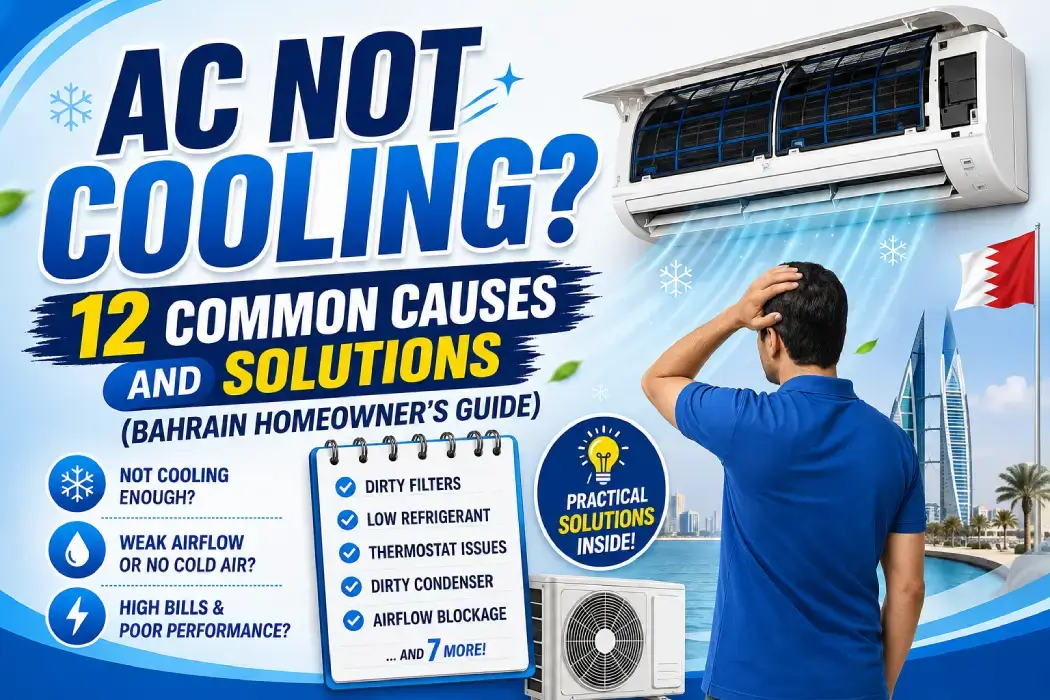
If you’ve ever sat in front of your AC unit in the middle of a Bahrain summer, felt the fan blowing, and realized the air coming out is warm instead of cold, you already know how frustrating it is. It’s one of the most common calls we get, and it’s rarely as simple as “the AC is broken.” There’s usually a specific reason behind it, and most of the time, it’s fixable.
This guide walks through the 12 most common reasons a Bahrain AC stops cooling properly, how to tell them apart, what you can safely check yourself, and when it’s time to call a certified technician instead of guessing.
Quick Answer
An AC usually stops cooling because of a dirty air filter, low refrigerant (gas) from a leak, a faulty compressor, a blocked condenser unit, a broken thermostat, or frozen evaporator coils. In Bahrain’s heat and humidity, dirty filters and low gas levels are by far the most frequent culprits, especially on units that haven’t had maintenance in over a year.
Why AC Cooling Problems Are So Common in Bahrain
Bahrain’s climate is brutal on air conditioning systems for months at a time. Summer temperatures regularly climb past 45°C, and units run almost continuously from May through September. That kind of workload wears down parts faster than in milder climates, and it also means small problems get noticed immediately, because there’s no room for a system running at half capacity.
Homes in Manama, Riffa, Muharraq, Isa Town, Hamad Town, Seef, and Juffair all deal with the same core issue: AC units that are asked to do more work, more often, than they were designed for in cooler regions. Add sea-level humidity into the mix, and you get faster dust buildup, coil corrosion, and drainage issues. None of this means your unit is doomed, but it does mean preventive maintenance matters more here than almost anywhere else.
1. Dirty or Clogged Air Filter
This is the single most common cause of weak cooling, and it’s the easiest to fix. When the filter fills up with dust, it restricts airflow over the evaporator coil, which reduces how much heat the system can pull out of the room.
Symptoms: Weak airflow from vents, AC running longer than usual, higher electricity bills, musty smell.
What to do: Check the filter monthly during peak summer months. Most split AC filters can be removed, rinsed with water, dried completely, and reinserted. If the filter looks gray, matted, or torn, replace it rather than clean it again.
2. Low Refrigerant (Gas Leak)
Refrigerant, often called “gas” by homeowners, is what actually absorbs heat from your room and releases it outside. It doesn’t get “used up” like fuel. If your AC is low on refrigerant, that almost always means there’s a leak somewhere in the line set or coil.
Symptoms: Ice forming on the copper pipes or indoor unit, hissing sound near the unit, AC blowing air that’s only slightly cool, cooling takes much longer than normal.
Low refrigerant is not something to top up repeatedly without finding the leak first. Recharging gas without repairing the leak just means you’ll be back to square one within weeks, and it wastes money on repeat visits.
3. Blocked or Dirty Condenser Unit (Outdoor Unit)
The outdoor condenser releases the heat your AC pulls out of the house. If it’s covered in dust, leaves, or sitting too close to a wall, it can’t release that heat properly, which drags down the entire cooling cycle.
Symptoms: AC runs constantly without reaching set temperature, outdoor unit feels unusually hot, higher energy consumption.
What to do: Keep at least 60cm of clearance around the outdoor unit. Rinse the condenser fins gently with a hose (never a pressure washer) every few months, especially if it’s near a garden, parking area, or construction dust.
4. Faulty Thermostat
Sometimes the AC itself is working fine, but the thermostat is sending the wrong signals, telling the compressor to shut off before the room actually reaches the set temperature.
Symptoms: Inconsistent temperatures room to room, AC shutting off too early, display showing a temperature that doesn’t match how the room actually feels.
A faulty thermostat is often overlooked because people assume the problem is mechanical. Testing this usually just requires a technician to check calibration or, in older units, replace the sensor.
5. Frozen Evaporator Coil
When airflow is restricted (dirty filter, blocked vents, low refrigerant), moisture on the evaporator coil can freeze instead of draining away. Once ice builds up, the coil can’t absorb heat at all, and the unit effectively stops cooling.
Symptoms: Visible ice or frost on the indoor unit, water dripping once you turn the unit off, weak or no airflow.
What to do: Turn the AC off completely and let the ice melt naturally, this can take a few hours. Do not try to chip the ice off. Once melted, check the filter and airflow before running it again. If it freezes again quickly, there’s likely a refrigerant or airflow issue that needs a technician.
6. Compressor Problems
The compressor is the heart of the cooling system. If it’s failing, weak, or not starting properly, the whole unit can run without producing real cooling.
Symptoms: Outdoor unit fan runs but there’s no cooling, unusual clicking or humming from the outdoor unit, AC trips the breaker repeatedly, compressor feels hot to the touch.
Compressor issues are one of the few problems on this list that are never DIY territory. They involve high-voltage electrical components and pressurized refrigerant lines, and a compressor replacement is also one of the bigger repair-vs-replace decision points for older units.
7. Dirty Evaporator Coil
Even without freezing, a coil coated in dust and grime loses much of its ability to absorb heat. This builds up slowly over months, so cooling performance often declines gradually rather than failing all at once.
Symptoms: Gradual drop in cooling over weeks or months, slightly reduced airflow, higher humidity indoors despite AC running.
Coil cleaning is typically part of a professional maintenance visit, since it requires partial disassembly of the indoor unit and the right cleaning solution to avoid damaging the coil fins.
8. Blocked or Dirty Air Vents and Ducts
For central AC and ducted systems, blocked vents or dust-filled ductwork restrict airflow the same way a dirty filter does, just further along the system. This is common in villas and offices with central AC that haven’t had ductwork inspected in a while.
Symptoms: Some rooms cool fine while others stay warm, weak airflow from specific vents, dusty smell when the AC starts.
9. Incorrect Unit Size for the Room
An undersized AC unit will run constantly and still struggle to cool a large room, especially with Bahrain’s heat pushing through windows and walls all day. This isn’t a malfunction, it’s a mismatch between the unit’s capacity and the space it’s cooling.
Symptoms: AC never quite reaches the set temperature, runs nonstop during peak afternoon heat, cools fine at night but struggles from midday onward.
If this sounds familiar, the fix isn’t repair, it’s reassessing whether the unit’s tonnage actually matches the room size, sun exposure, and number of people typically inside.
10. Electrical or Wiring Issues
Loose connections, a failing capacitor, or wiring problems can prevent the compressor or fan motor from running at full power, even if every mechanical part is fine.
Symptoms: AC turns on and off unexpectedly, unusual buzzing or humming, breaker trips when the AC starts, fan runs slower than normal.
Electrical issues carry real safety risk. Never open the electrical panel of an AC unit yourself, this is strictly a job for a certified technician with the right testing equipment.
11. Blocked Drain Line Affecting Performance
While a clogged drain line is more commonly known for causing leaks, a severely blocked line can trigger safety switches in some units that reduce or stop cooling to prevent water damage.
Symptoms: AC cooling weakly alongside visible water pooling, unit shutting off shortly after starting, error codes on units with digital displays.
12. Aging System (Nearing End of Lifespan)
Most split AC units in Bahrain are expected to perform well for 8 to 12 years with proper maintenance. Past that point, components wear down together, and cooling efficiency drops even when there’s no single obvious fault.
Symptoms: Frequent repairs over the past year, rising energy bills without a clear cause, cooling capacity noticeably weaker than when new.
Step-by-Step Troubleshooting Before Calling a Technician
- Check the thermostat setting and mode (make sure it’s on “cool,” not “fan” or “auto” with a high target temperature).
- Inspect and clean the air filter.
- Look at the indoor unit for ice buildup. If present, switch off and let it thaw.
- Check the outdoor unit for blockages, debris, or objects placed too close to it.
- Listen for unusual sounds: hissing, clicking, or grinding.
- Check the circuit breaker to confirm the unit is getting consistent power.
- Note how long the AC has been running without cooling and whether it’s gotten worse gradually or suddenly.
If cooling doesn’t improve after these checks, it’s time to bring in a professional rather than keep guessing.
DIY vs Professional Repair
| Task | DIY Appropriate | Professional Required |
|---|---|---|
| Cleaning/replacing air filter | Yes | — |
| Clearing debris from outdoor unit | Yes | — |
| Thawing a frozen coil | Yes | — |
| Refrigerant recharge or leak repair | No | Yes |
| Compressor diagnosis or replacement | No | Yes |
| Electrical or wiring repair | No | Yes |
| Coil cleaning (deep clean) | No (risk of damage) | Yes |
| Thermostat calibration/replacement | No | Yes |
Common Mistakes Homeowners Make
- Repeatedly adding refrigerant without fixing the underlying leak.
- Running the AC continuously while it’s frozen, which can damage the compressor.
- Ignoring rising electricity bills as just “normal Bahrain summer costs.”
- Placing outdoor units in tight, enclosed spaces with no airflow.
- Waiting until the unit stops completely instead of addressing early warning signs.
- Attempting electrical repairs without proper training or tools.
Safety Precautions
Always switch off the AC at the breaker before inspecting the indoor unit. Never touch the outdoor unit’s electrical components. Avoid using sharp tools to remove ice from a frozen coil. If you smell burning or notice smoke, turn off the unit immediately and contact a technician rather than continuing to test it.
What Affects Repair Cost
Costs vary based on a few honest factors rather than a flat number:
- Type of issue – a filter clean costs far less than a compressor replacement.
- Refrigerant type – older R22 systems can cost more to recharge than newer R410A units.
- Unit type – split AC repairs are typically simpler than central or chiller AC repairs.
- Age and accessibility – units in hard-to-reach locations or very old models may need more labor.
- Parts availability – some compressor or PCB parts may need to be sourced, affecting turnaround time.
Rather than guessing at pricing, a technician visit typically includes a diagnosis first, so you know exactly what’s being repaired and why before committing to a cost.
Repair vs Replacement Guidance
As a general rule, if your unit is under 8 years old and the issue is isolated (filter, gas leak, single component), repair almost always makes sense. If the unit is past 10-12 years, has had multiple repairs in the last year, or needs a compressor replacement, it’s worth comparing that repair cost against a new, more energy-efficient unit, especially given how much AC units run during Bahrain summers.
Preventive Maintenance Checklist
- Clean or replace air filters monthly during summer, every 2 months in cooler seasons.
- Schedule professional maintenance at least twice a year, ideally before and mid-way through summer.
- Keep the outdoor condenser unit clear of dust, leaves, and obstructions.
- Check the drain line for clogs every few months.
- Monitor energy bills for unexplained increases.
- Have refrigerant levels checked annually, even without obvious symptoms.
- Avoid setting the thermostat unnecessarily low, which strains the compressor.
When to Call a Certified Technician
If you’ve gone through the basic checks above and cooling still isn’t right, or if you notice ice, unusual smells, electrical issues, or repeated breaker trips, it’s time to bring in a certified technician. These are signs of underlying issues, refrigerant, compressor, or electrical, that need proper diagnostic tools and experience to fix safely and correctly. For AC problems anywhere in Bahrain, from a single split unit at home to a full central system in a commercial property, Fix Bahrain’s AC repair service in Bahrain covers diagnosis, gas refill, compressor repair, and full system servicing.
Related Reading
If your AC is cooling but you’ve noticed other issues, these related guides may help:
- AC Water Leakage: Causes and Fixes
- AC Gas Refill: What Homeowners Should Know
- AC Maintenance Guide for Bahrain Summers
- AC Compressor Problems: Warning Signs to Watch
And if it’s not your AC giving you trouble, Fix Bahrain also covers refrigerator repair, washing machine repair, dryer repair, dishwasher repair, electric stove repair, chiller AC repair, and iron repair across Bahrain.
Conclusion
An AC that’s not cooling properly is almost never a mystery once you know what to look for. Most cases trace back to a handful of causes: a dirty filter, low refrigerant from a leak, a blocked condenser, or a component nearing the end of its life. The good news is that many of these problems are preventable with regular maintenance, and the ones that aren’t are usually straightforward for a trained technician to diagnose and fix.
If your AC still isn’t cooling after checking the basics, don’t wait for it to get worse in the middle of a Bahrain heatwave. Reach out to Fix Bahrain’s AC repair team for a proper diagnosis and same-day service across Manama, Riffa, Muharraq, and the rest of Bahrain.
Frequently Asked Questions
Why is my AC running but not cooling the room?
This usually means the compressor isn’t working properly, refrigerant levels are low, or airflow is restricted by a dirty filter or blocked coil. The fan running doesn’t mean the cooling cycle itself is functioning, those are two separate systems working together.
Why does my AC blow warm air sometimes and cold air other times?
Inconsistent temperatures often point to a failing thermostat, a partially frozen coil that’s thawing and refreezing, or low refrigerant causing the system to struggle intermittently. It’s worth having a technician check this rather than waiting for it to fully fail.
Can I add refrigerant to my AC myself?
This isn’t recommended. Refrigerant handling requires certification in most cases, and simply adding gas without finding and repairing the underlying leak means the same problem will return within weeks.
How often should I clean my AC filter in Bahrain?
During peak summer months (May to September), check and clean the filter monthly. In cooler months, every 6 to 8 weeks is usually sufficient, depending on dust levels in your area.
Why is my AC freezing up?
Ice buildup usually results from restricted airflow (dirty filter, blocked vents) or low refrigerant. Turn the unit off, let it thaw fully, and check the filter before running it again. If it refreezes, call a technician.
Is it normal for my AC to run constantly during Bahrain summer?
Some extended running is normal in extreme heat, but if it never reaches the set temperature or runs nonstop even at night, that points to a sizing mismatch, refrigerant issue, or component problem.
How long should an AC unit last before needing replacement?
Most split AC units last 8 to 12 years with regular maintenance. Central and chiller systems can last longer with proper servicing, but efficiency naturally declines with age.
Why is my electricity bill higher even though my AC seems to work fine?
A unit working harder than necessary, due to a dirty filter, blocked condenser, or low refrigerant, uses significantly more electricity even if it’s still producing some cooling. Rising bills are often an early warning sign before total failure.
Should I repair or replace my AC if the compressor fails?
It depends on the unit’s age. For units under 8 years old, compressor replacement is often worthwhile. For older units, especially past 10-12 years, comparing the repair cost to a new, more efficient unit usually makes more financial sense.
Can a dirty outdoor unit really affect cooling that much?
Yes. The outdoor condenser releases the heat pulled from indoors. If it’s blocked by dust, debris, or poor placement, that heat has nowhere to go, which reduces the entire system’s cooling capacity.
What’s the difference between a split AC and central AC problem when it comes to cooling?
Split AC issues are usually isolated to one unit and easier to diagnose. Central AC problems can involve ductwork, multiple zones, or a shared compressor, meaning one issue can affect cooling across several rooms at once.
Is it safe to keep running my AC if it’s not cooling properly?
It depends on the cause. If it’s simply a dirty filter, it’s safe short-term, though inefficient. If you notice burning smells, tripped breakers, or unusual sounds, turn it off and call a technician rather than continuing to run it.